Heart failure
Impaired cardiac output / filling → neurohormonal activation and congestion
Overview
A clinical syndrome of breathlessness, fatigue and fluid overload from impaired ventricular function. Split by ejection fraction: HFrEF (≤40%, systolic — the type with prognostic drug therapy) and HFpEF (preserved EF, diastolic). NT-proBNP triages referral; the four-pillar drug therapy (ACEi/ARB/ARNI + beta-blocker + MRA + SGLT2 inhibitor) transforms HFrEF outcomes.
Recognise
- Exertional dyspnoea, orthopnoea, paroxysmal nocturnal dyspnoea, fatigue; raised JVP, bibasal crackles, peripheral/sacral oedema, displaced apex, 3rd heart sound
- NYHA class I–IV grades functional limitation; right heart failure → ascites, hepatomegaly, peripheral oedema
- CXR: cardiomegaly, upper-lobe diversion, Kerley B lines, alveolar (bat-wing) oedema, pleural effusions
Red flags
- Acute pulmonary oedema (severe dyspnoea, pink frothy sputum, hypoxia) → sit up, oxygen, IV loop diuretic ± nitrates → cross-ref acute_care
- NT-proBNP >2000 ng/L → urgent (2-week) referral + echo; cardiogenic shock → inotropes/critical care
Differentials & how to tell them apart
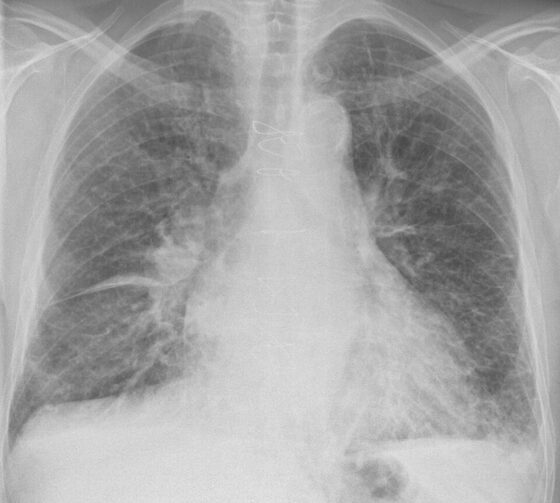
Pulmonary oedema — Kerley B lines and interstitial shadowing (chest X-ray)
Mikael Häggström / CC0 — Wikimedia Commons
Investigations
NT-proBNP (the key triage test — high → echo/referral; normal makes HF unlikely); transthoracic echo (EF, structure, valves); ECG; CXR; bloods (FBC, U&Es, TFTs, glucose, iron studies); identify the cause (ischaemia/valve/hypertension).
Management
HFrEF: ACEi/ARB + beta-blocker + MRA + SGLT2 inhibitor (four pillars); loop diuretic for symptoms
- 1Measure NT-proBNP and arrange echo to confirm and classify (HFrEF vs HFpEF). Treat the cause and risk factors.Gate: NT-proBNP >2000 ng/L → refer for specialist assessment and echo within 2 weeks; 400–2000 → within 6 weeks. Acute pulmonary oedema → emergency management (oxygen, IV furosemide, nitrates).
- 2HFrEF: start the four pillars (ACEi/ARB ± switch to ARNI, beta-blocker, MRA, SGLT2 inhibitor) and a loop diuretic for congestion. HFpEF: treat comorbidities + SGLT2 inhibitor + diuretic for congestion.Gate: Loop diuretics relieve symptoms but do not improve survival — don't rely on them alone; the prognostic benefit is in the four pillars.
- 3Persistent symptoms/low EF → device therapy (CRT/ICD), specialist escalation, consider transplant/advanced therapies; offer cardiac rehab and the annual flu/pneumococcal vaccines.
Key points
Breathless + raised JVP + bibasal crackles + oedema → NT-proBNP then echo. HFrEF (EF ≤40%) is the prognostic-treatment type: the four pillars (ACEi/ARB/ARNI, beta-blocker, MRA, SGLT2 inhibitor). Loop diuretics treat symptoms, not survival.
Monitor & prognosis
Weight/fluid status, U&Es (ACEi/MRA), symptoms/NYHA class, EF on echo; titrate the four pillars.
HFrEF prognosis is markedly improved by the four pillars; advanced HF carries high mortality.
Source: NICE NG106 (chronic heart failure)