Raynaud's & vasospastic disorders
Episodic digital arterial vasospasm — primary or secondary to connective tissue disease
Overview
Episodic vasospasm of the digital arteries causing the classic triphasic colour change (white → blue → red) on cold/emotion. Primary Raynaud's disease is benign and symmetrical in young women; secondary Raynaud's phenomenon points to an underlying disorder (especially connective tissue disease such as systemic sclerosis) and can cause digital ulceration/ischaemia. Buerger's disease (thromboangiitis obliterans) is a related smoking-related digital ischaemia in young men.
Recognise
- Triphasic digital colour change: pallor (white) → cyanosis (blue) → reactive hyperaemia (red), with pain/numbness, triggered by cold/emotion
- Primary: young women, symmetrical, no tissue damage, normal nailfold capillaries, negative autoantibodies
- Secondary clues: older onset, asymmetry, digital ulcers/pitting, abnormal nailfold capillaries, positive ANA/anti-centromere/anti-Scl-70 (systemic sclerosis)
Red flags
- Digital ulceration/critical ischaemia → urgent treatment (secondary Raynaud's)
- New Raynaud's in an older patient or with systemic features → search for connective tissue disease or malignancy
Differentials & how to tell them apart
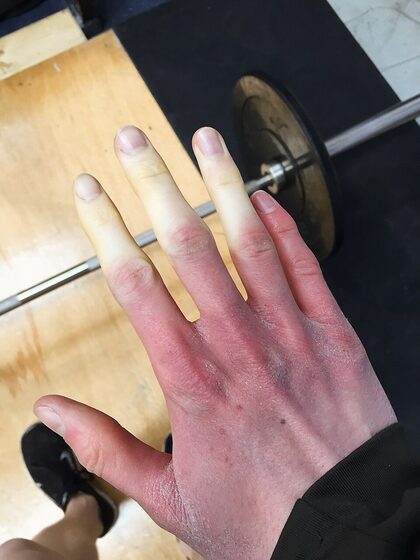
Raynaud's phenomenon — demarcated pallor of the digits
Jmesy / CC BY-SA 4.0 — Wikimedia Commons
Investigations
Clinical diagnosis; nailfold capillaroscopy and autoantibodies (ANA, anti-centromere, anti-Scl-70) to distinguish primary from secondary; investigate for the associated connective tissue disease; Buerger's → angiography (corkscrew collaterals), smoking history.
Management
Keep warm + stop smoking; nifedipine for symptoms; treat any underlying connective tissue disease
- 1Distinguish primary (young woman, symmetrical, normal capillaries/autoantibodies) from secondary (autoantibodies, nailfold changes, ulceration). Conservative measures + nifedipine for symptoms.Gate: Digital ulceration, asymmetry, abnormal nailfold capillaries or positive autoantibodies → secondary Raynaud's → investigate and treat the underlying connective tissue disease; new onset in older patients warrants a cause search.
- 2Secondary disease/critical digital ischaemia → IV iloprost/PDE5 inhibitors and treat the cause; Buerger's disease → complete smoking cessation (the only effective treatment).
Key points
Triphasic white→blue→red digital colour change on cold = Raynaud's. Young woman, symmetrical, normal autoantibodies = primary (benign) → keep warm + nifedipine. Ulcers/asymmetry/positive ANA/abnormal nailfold capillaries = secondary → hunt connective tissue disease. Young male smoker with digital ischaemia = Buerger's → stop smoking.
Monitor & prognosis
Symptom frequency, digital integrity, autoantibody/connective-tissue surveillance.
Primary disease is benign; secondary disease tracks the underlying condition and can threaten digits.
Source: NICE CKS (Raynaud's); cross-ref rheumatology