Supraventricular tachycardia (SVT)
Re-entry circuit at/above the AV node (AVNRT, AVRT incl. WPW)
Overview
A regular narrow-complex tachycardia (typically 150–250) from a re-entry circuit involving the AV node — AVNRT (commonest) or AVRT via an accessory pathway (e.g. WPW). Acute termination uses vagal manoeuvres then adenosine; the key trap is pre-excited AF in WPW, where AV-node-blocking drugs are dangerous.
Recognise
- Sudden-onset regular palpitations, often in young patients; may have chest tightness, dyspnoea, light-headedness, polyuria
- ECG: regular narrow-complex tachycardia ~150–250, P waves absent or buried/retrograde
- WPW (between episodes): short PR + delta wave (slurred QRS upstroke)
Red flags
- Haemodynamic instability → synchronised DC cardioversion
- Irregular broad-complex tachycardia = pre-excited AF (WPW) → AVOID adenosine/verapamil/digoxin/beta-blockers (can precipitate VF) → use flecainide/amiodarone or cardioversion
Differentials & how to tell them apart
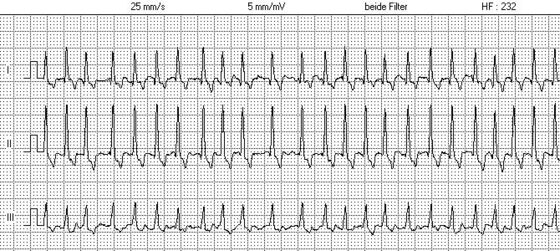
SVT — regular narrow-complex tachycardia (ECG)
Kalumet / CC BY-SA 3.0 — Wikimedia Commons
Investigations
12-lead ECG during and after the episode (look for delta wave/short PR of WPW); electrolytes, TFTs. Electrophysiology study if recurrent/for ablation.
Management
Vagal manoeuvres → IV adenosine (rapid bolus, cardiac monitor)
- 1If stable and narrow-complex regular: vagal manoeuvres (modified Valsalva), then rapid-bolus IV adenosine 6→12→18 mg with continuous ECG.Gate: If unstable (shock/syncope/ischaemia) → synchronised DC cardioversion. If the rhythm is irregular and broad = pre-excited AF (WPW) → do NOT give adenosine/verapamil/digoxin/beta-blockers; use flecainide/amiodarone or cardiovert.
- 2Recurrent episodes: long-term beta-blocker or rate-limiting CCB; refer for catheter ablation (curative for AVNRT/AVRT and symptomatic WPW). Adenosine contraindicated in asthma → verapamil instead.
Key points
Young patient, abrupt regular narrow-complex tachycardia ~180 = SVT → vagal manoeuvres then adenosine. Delta wave + short PR = WPW; if they go into irregular broad-complex AF, AV-node blockers can precipitate VF — cardiovert or use flecainide/amiodarone.
Monitor & prognosis
ECG during termination; recurrence frequency; ablation outcome.
Excellent; ablation is curative in most.
Source: Resuscitation Council UK tachycardia algorithm; NICE CKS