Acromegaly
Growth hormone excess (usually a pituitary somatotroph adenoma)
Overview
Growth hormone excess, almost always from a pituitary somatotroph adenoma (rarely ectopic GHRH). In adults (after growth plates fuse) it causes acromegaly — insidious soft-tissue and bony overgrowth; before fusion it causes gigantism. Diagnosed by failure of GH to suppress on an oral glucose tolerance test + raised IGF-1; treated by transsphenoidal surgery.
Recognise
- Coarsening facial features, enlarging hands/feet (ring/shoe size up), prognathism, macroglossia, interdental spacing, frontal bossing
- Sweating, headaches, carpal tunnel syndrome, arthralgia, skin tags; deep voice
- Systemic: hypertension, impaired glucose tolerance/diabetes, cardiomyopathy, colonic polyps; bitemporal hemianopia (chiasm) if macroadenoma
Red flags
- Visual field loss (bitemporal hemianopia) / pituitary apoplexy → urgent
- Cardiovascular and colorectal cancer risk → surveillance
Differentials & how to tell them apart
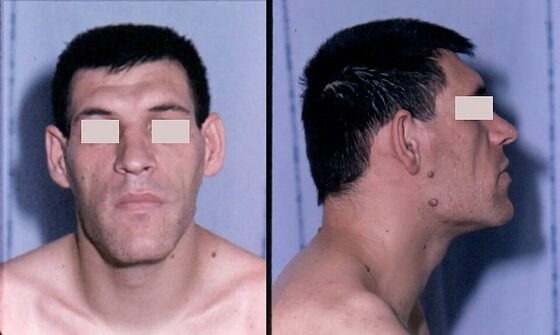
Acromegaly — coarse facial features and prognathism
Philippe Chanson & Sylvie Salenave / CC BY 2.0 — Wikimedia Commons
Investigations
IGF-1 (screening, raised); ORAL GLUCOSE TOLERANCE TEST with GH measurement — failure of GH to suppress is diagnostic. MRI pituitary; visual fields; assess other pituitary axes.
Management
Transsphenoidal surgery (somatostatin analogue if residual)
- 1Confirm with IGF-1 then OGTT-GH (no suppression). MRI pituitary, visual fields, full pituitary assessment. Transsphenoidal surgery is first-line.Gate: A macroadenoma compressing the optic chiasm (bitemporal hemianopia) or pituitary apoplexy is urgent; screen and treat the systemic complications (cardiovascular disease, diabetes, colonic polyps) that drive mortality
- 2Residual disease → somatostatin analogue (octreotide/lanreotide), pegvisomant, cabergoline, or radiotherapy; lifelong biochemical/complication surveillance.
Key points
Coarse features + enlarging hands/feet + sweating + carpal tunnel + an OGTT that fails to suppress GH = acromegaly. Don't forget the chiasm (bitemporal hemianopia) and the colon (polyps/cancer).
Monitor & prognosis
IGF-1; visual fields; CV and colonic surveillance.
Good if cured; excess mortality (CV) if uncontrolled.
Source: Society for Endocrinology; Endocrine Society