Cushing syndrome
Chronic glucocorticoid excess (exogenous steroids, or endogenous ACTH-dependent/independent)
Overview
Chronic cortisol excess. Commonest cause is EXOGENOUS (prescribed steroids). Endogenous: ACTH-dependent (pituitary adenoma = Cushing's DISEASE, or ectopic ACTH from small-cell lung/carcinoid) or ACTH-independent (adrenal adenoma/carcinoma). Central obesity, striae, proximal myopathy, hypertension and hyperglycaemia. Confirm cortisol excess, then localise.
Recognise
- Central obesity, moon face, interscapular/supraclavicular fat, thin skin with purple STRIAE, easy bruising
- PROXIMAL myopathy (can't rise from a chair), hypertension, impaired glucose tolerance/diabetes, osteoporosis, mood change
- Hyperpigmentation if ACTH-dependent; hypokalaemic alkalosis (esp. ectopic ACTH, which is often rapid with weight loss not gain)
Red flags
- Rapid onset + weight loss + hypokalaemia + pigmentation → ectopic ACTH (often small-cell lung cancer) — investigate for malignancy
- Severe hypertension/hyperglycaemia/psychosis from cortisol excess
Differentials & how to tell them apart
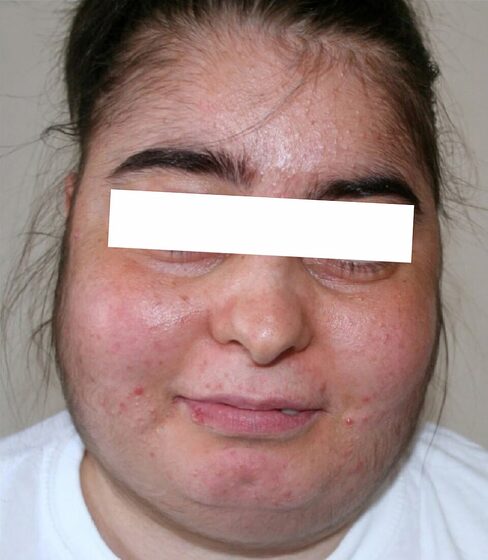
Cushingoid features — moon face / central adiposity
Ozlem Celik, Mutlu Niyazoglu et al / CC BY 2.5 — Wikimedia Commons
Investigations
First confirm cortisol excess: overnight/low-dose DEXAMETHASONE suppression test (fails to suppress), late-night salivary cortisol, or 24-h urinary free cortisol. Then ACTH (suppressed = adrenal; normal/high = ACTH-dependent) and localise (high-dose dexamethasone, MRI pituitary, CT chest/abdomen, IPSS).
Management
Confirm cortisol excess + localise → treat the cause (surgery; taper exogenous steroids)
- 1Establish cortisol excess (dexamethasone suppression/late-night salivary/urinary cortisol), then measure ACTH and localise. Commonest cause is exogenous steroids — review and taper.Gate: NEVER stop long-term exogenous steroids abruptly (precipitates adrenal crisis) — taper; a suppressed ACTH points to an adrenal tumour, a normal/high ACTH to pituitary (Cushing's disease) or ectopic source
- 2Definitive: transsphenoidal surgery (Cushing's disease), adrenalectomy (adrenal tumour), treat the ectopic tumour; medical therapy (metyrapone/ketoconazole) bridges to surgery.
Key points
Central obesity + striae + proximal myopathy + hypertension + hyperglycaemia. Step 1 confirm cortisol excess (dexamethasone), step 2 localise with ACTH. Rapid + weight loss + hypokalaemia = ectopic ACTH (think lung). The commonest cause overall is the steroids you prescribed.
Monitor & prognosis
Cortisol axis post-treatment; replace if hypoadrenal after cure.
Good if treated; cardiovascular/metabolic risk if untreated.
Source: CKS Cushing's; Endocrine Society