Paget's disease of the nipple
Intraepidermal spread of underlying breast carcinoma to the nipple
Overview
An eczema-like change of the NIPPLE caused by malignant ductal carcinoma cells spreading into the nipple epidermis — almost always associated with an underlying in-situ or invasive breast cancer. The trap is treating it as eczema. Unlike eczema, it starts on and destroys the NIPPLE (not the areola) and is unilateral and persistent.
Recognise
- Unilateral, persistent, eczema-like (red, scaly, crusted, itchy/burning) change involving the NIPPLE, ± ulceration/bleeding and nipple destruction/retraction
- Starts on the nipple and spreads to the areola (eczema does the opposite); may have an underlying palpable lump
- Almost always an underlying breast carcinoma (DCIS or invasive)
Red flags
- A persistent unilateral nipple 'eczema' not responding to topical steroids → refer (cancer pathway), biopsy
- Underlying mass on imaging
Differentials & how to tell them apart
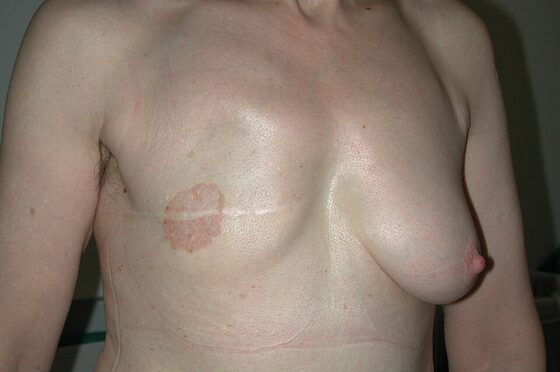
Paget's disease of the nipple — eczema-like nipple change
Monica Giovannini et al / CC BY-SA 2.0 — Wikimedia Commons
Investigations
Suspected-cancer referral; mammography/ultrasound; nipple/skin biopsy (Paget cells); assess for the underlying carcinoma.
Management
Biopsy + treat the underlying breast carcinoma (NOT topical steroids)
- 1Refer any persistent unilateral nipple eczema on a suspected-cancer pathway; mammography/ultrasound and biopsy. Treat the underlying carcinoma.Gate: Do NOT keep treating it as eczema — unilateral, nipple-centred, persistent change is Paget's of the nipple (an underlying cancer) until biopsy proves otherwise; eczema is bilateral, areola-centred and steroid-responsive
- 2Surgery (mastectomy or central excision) ± sentinel node and adjuvant therapy according to the underlying tumour.
Key points
Persistent unilateral nipple 'eczema' that starts on the NIPPLE and destroys it = Paget's of the nipple (underlying cancer). Eczema is bilateral, areolar and steroid-responsive. Biopsy, don't keep steroiding.
Monitor & prognosis
As for the underlying breast cancer.
Depends on the underlying carcinoma.
Source: NICE NG101