Perforated tympanic membrane
Rupture of the eardrum (infection, trauma, barotrauma)
Overview
A defect in the tympanic membrane from acute otitis media (most common), direct/penetrating trauma (cotton bud), barotrauma or a blast injury. Most heal spontaneously; the management points are keeping the ear dry and avoiding ototoxic drops.
Recognise
- Sudden ear pain relief with otorrhoea (when AOM perforates), or sudden pain/bleeding/hearing loss after trauma
- Conductive hearing loss (size-dependent); tinnitus
- Otoscopy shows the perforation
Red flags
- Perforation with vertigo/sensorineural loss after trauma → suspect ossicular/inner-ear injury (perilymph fistula) → urgent ENT; cholesteatoma in a chronic marginal perforation
Differentials & how to tell them apart
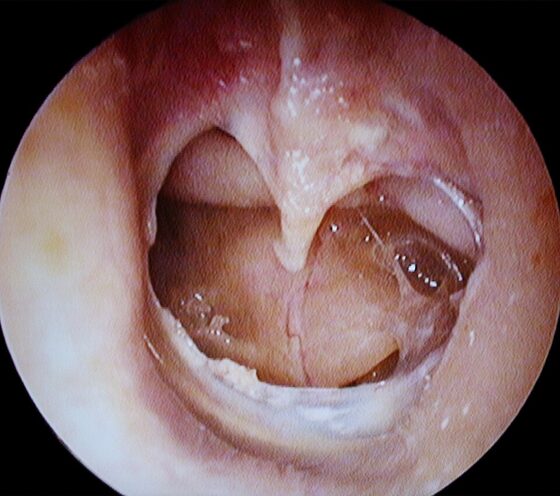
Perforated tympanic membrane
Didier Descouens / CC BY-SA 4.0 — Wikimedia Commons
Investigations
Otoscopy; audiometry if hearing loss persists. Persistent perforation/discharge → ENT.
Management
Keep the ear dry + analgesia; most heal spontaneously (avoid aminoglycoside drops)
- 1Reassure — most traumatic/AOM perforations heal within 6–8 weeks. Keep the ear dry (water precautions); analgesia; treat associated infection.Gate: If ear drops are needed with a (possible) perforation, use a QUINOLONE (ciprofloxacin), NOT an aminoglycoside — aminoglycosides are ototoxic through a perforation
- 2Persistent perforation (>6–8 weeks), recurrent infection, or hearing loss → ENT for review ± myringoplasty; exclude cholesteatoma in chronic marginal perforations.
Key points
Most heal alone. The two safety points: water precautions and no aminoglycoside drops. Vertigo/SNHL after trauma suggests inner-ear injury — refer urgently.
Monitor & prognosis
Healing over weeks; persistent perforation/hearing loss → ENT.
Most heal; large/chronic perforations may need myringoplasty.
Source: NICE CKS; ENT UK