Crohn disease
Transmural granulomatous inflammation anywhere mouth-to-anus (smoking worsens)
Overview
A chronic relapsing inflammatory bowel disease — transmural, granulomatous inflammation that can affect ANY part of the gut (mouth to anus), classically the terminal ileum, with SKIP lesions. Causes diarrhoea (often non-bloody), abdominal pain, weight loss and perianal disease, with strictures and fistulae. Smoking WORSENS it. Managed by inducing then maintaining remission (steroids → thiopurines/methotrexate → biologics); surgery is not curative.
Recognise
- Chronic diarrhoea (often non-bloody), crampy abdominal pain (often right iliac fossa/terminal ileum), weight loss, mouth ulcers, perianal disease (fistulae, abscess, skin tags)
- Transmural, SKIP lesions, cobblestoning, strictures, fistulae; non-caseating granulomas; B12/iron deficiency
- Extra-intestinal: erythema nodosum, pyoderma gangrenosum, uveitis/episcleritis, arthritis, gallstones, renal oxalate stones; smoking worsens disease
Red flags
- Acute severe flare, obstruction (stricture), abscess/fistula, perforation, toxic dilatation → urgent
- Long-standing colitis → colorectal cancer surveillance
Differentials & how to tell them apart
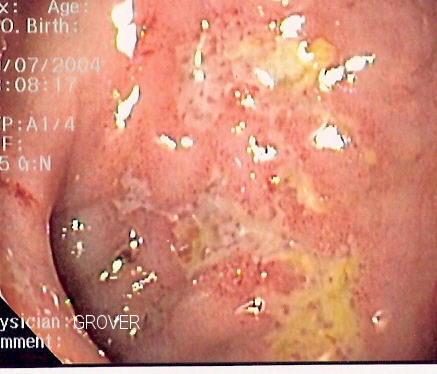
Crohn disease — cobblestoning/deep ulceration of the bowel mucosa (endoscopy)
see Commons / CC BY-SA 3.0 — Wikimedia Commons
Investigations
FBC (anaemia), CRP, faecal CALPROTECTIN (raised), B12/folate/iron; COLONOSCOPY + biopsy (skip lesions, cobblestoning, granulomas); MRI/CT enterography (small bowel, fistulae); MRI pelvis for perianal disease.
Management
Corticosteroid to induce remission; thiopurine/biologic to maintain (+ stop smoking)
- 1Induce remission with corticosteroids (budesonide for ileocaecal disease); strongly advise SMOKING CESSATION. Maintain remission with a thiopurine or methotrexate; biologics (anti-TNF) for severe/refractory/perianal/fistulating disease.Gate: Corticosteroids INDUCE but must NOT be used to MAINTAIN remission (use a thiopurine/biologic); SMOKING worsens Crohn (the opposite of UC) — cessation is part of treatment; surgery is not curative (disease recurs)
- 2Surgery for strictures/fistulae/abscess/obstruction (not curative); CRC surveillance in colonic disease; manage extra-intestinal manifestations and nutrition.
Key points
Skip lesions + transmural + perianal + non-bloody diarrhoea + smoking WORSENS = Crohn. Steroids induce, thiopurine/biologic maintains. Mouth-to-anus, granulomas, fistulae. The smoking direction is the classic UC discriminator.
Monitor & prognosis
Calprotectin/CRP, symptoms, drug monitoring (thiopurine FBC/LFTs); CRC surveillance.
Relapsing-remitting; surgery common but not curative.
Source: NICE NG129; CKS Crohn's disease