Gastrointestinal perforation
Full-thickness breach of the GI tract → peritoneal contamination (free gas)
Overview
A full-thickness breach of the gut wall, spilling contents into the peritoneum and causing peritonitis. Causes by site: perforated peptic ulcer (upper), perforated diverticulitis/appendicitis/cancer/ischaemia (lower), Boerhaave (oesophagus). Presents with sudden severe abdominal pain and a rigid 'board-like' abdomen. The radiological hallmark is FREE intraperitoneal gas — sub-diaphragmatic on erect CXR, or pooling to the non-dependent side on a lateral decubitus film. An emergency: resuscitate and operate.
Recognise
- SUDDEN severe abdominal pain, then generalised PERITONITIS — rigid 'board-like' abdomen, guarding, rebound, lies still, shallow breathing, tachycardia/shock
- Loss of liver dullness (gas over the liver); absent bowel sounds; rapid deterioration/sepsis
- FREE GAS: erect CXR — air under the diaphragm; AXR — Rigler (double-wall) sign, football sign, falciform outline; LATERAL DECUBITUS — free gas rises to the NON-DEPENDENT side
Red flags
- Generalised peritonitis with free gas → emergency resuscitation + surgery
- Faecal peritonitis/septic shock — high mortality
Differentials & how to tell them apart
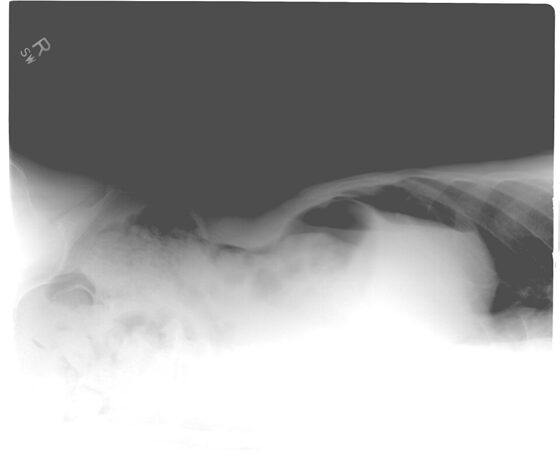
Pneumoperitoneum — free gas under the diaphragm on an erect chest X-ray (perforation)
Bill Rhodes / CC BY 2.0 — Wikimedia Commons
Investigations
ERECT CXR (air under the diaphragm — the classic film); if the patient can't sit up, LATERAL DECUBITUS film (free gas non-dependent). CT abdomen/pelvis (site/cause). FBC/U&Es/CRP/lactate/amylase, group & save, VBG.
Management
Resuscitate (fluids + antibiotics) + emergency surgery (repair/resection + washout)
- 1Resuscitate aggressively (IV fluids, broad-spectrum antibiotics, analgesia, NG tube, catheter) and confirm free gas (erect CXR, or lateral decubitus if the patient can't sit up). Urgent surgical referral.Gate: If the erect CXR is equivocal/the patient can't sit up, a LATERAL DECUBITUS film localises free gas to the NON-DEPENDENT side (the side they are NOT lying on) — distinguishing true free intraperitoneal gas (perforation) from bowel gas; free gas = laparotomy
- 2Emergency laparotomy: repair (omental/Graham patch for perforated ulcer), resect and wash out per cause; ITU/sepsis care.
Key points
Sudden severe pain + board-like rigid abdomen + free gas = perforation → resuscitate and operate. The film: air under the diaphragm on erect CXR, or — if they can't sit up — free gas pooling to the NON-dependent side on a decubitus film (the read that distinguishes free gas from luminal gas).
Monitor & prognosis
Sepsis/lactate; post-op critical care.
Depends on cause/contamination; faecal peritonitis is high-mortality.
Source: RCS; ACPGBI