Intestinal obstruction & ileus
Mechanical blockage (adhesions/hernia/tumour/volvulus) or functional ileus (post-op/metabolic)
Overview
Failure of aboral passage of bowel contents. MECHANICAL obstruction — small bowel (commonest: adhesions, hernias; also Crohn, tumour) or large bowel (commonest: colorectal cancer; also volvulus, diverticular stricture). Paralytic ILEUS — functional, no mechanical block (post-operative, electrolyte derangement, opioids, peritonitis). Presents with colicky pain, distension, vomiting and absolute constipation; AXR shows dilated loops. Decompress, resuscitate, and treat the cause.
Recognise
- Colicky abdominal pain, abdominal DISTENSION, VOMITING (early + bilious in small bowel; late + faeculent in large bowel), ABSOLUTE constipation (no flatus)
- Bowel sounds: tinkling/hyperactive (mechanical) vs absent (ileus); examine all hernial orifices and for scars (adhesions)
- AXR: dilated loops — SMALL bowel central with valvulae conniventes (full width), LARGE bowel peripheral with haustra (partial); fluid levels on erect film
Red flags
- Strangulation/ischaemia (constant pain, peritonism, fever, raised lactate) → emergency surgery
- Closed-loop obstruction (e.g. competent ileocaecal valve in LBO, volvulus) → high perforation risk
Differentials & how to tell them apart
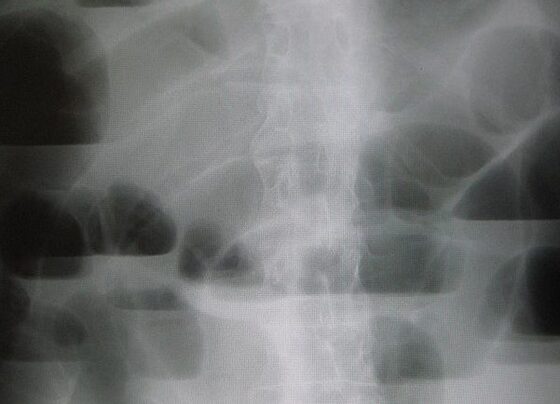
Small-bowel obstruction — dilated central loops with valvulae conniventes crossing the full width (AXR)
Igboeze / CC BY-SA 4.0 — Wikimedia Commons
Investigations
AXR (dilated loops, small vs large bowel), erect CXR (free air if perforated); CT abdomen/pelvis (cause, transition point, ischaemia, closed loop). U&Es (vomiting losses), FBC, lactate, VBG.
Management
'Drip and suck' (IV fluids + NG tube) + treat the cause (surgery if strangulation/closed loop)
- 1Resuscitate: IV fluids, correct electrolytes, NG decompression, nil by mouth, catheter, analgesia ('drip and suck'). CT to define the cause and check for ischaemia/closed loop. Adhesional small-bowel obstruction often settles conservatively.Gate: Signs of STRANGULATION/ischaemia (constant pain, peritonism, fever, raised lactate) or a CLOSED-LOOP obstruction = urgent surgery — don't persist with conservative management; a mechanical large-bowel obstruction is usually an obstructing CANCER until proven otherwise
- 2Surgery for strangulation/closed loop/non-resolving obstruction/obstructing tumour (resection ± stoma or stent); treat ileus by correcting the cause.
Key points
Colicky pain + distension + vomiting + absolute constipation = obstruction. AXR: small bowel = central, valvulae conniventes across the full width; large bowel = peripheral, haustra. Tinkling bowel sounds (mechanical) vs silent (ileus). Strangulation = surgery.
Monitor & prognosis
Fluid balance, electrolytes, lactate; resolution vs deterioration.
Good if uncomplicated; strangulation is dangerous.
Source: ACPGBI; RCS; NICE