Necrotising enterocolitis
Ischaemic-inflammatory necrosis of neonatal bowel (prematurity; bacterial invasion of the wall)
Overview
A serious neonatal GI emergency — ischaemic-inflammatory necrosis of the bowel wall, mainly in PREMATURE/low-birth-weight infants (also formula feeding, hypoxia). Presents in the first weeks with feed intolerance, bilious vomiting/aspirates, abdominal distension and bloody stools, progressing to systemic collapse. The AXR signs are key: PNEUMATOSIS INTESTINALIS (intramural gas) and portal venous gas; perforation gives free gas. (Primarily a child-health/neonatal condition — carried here for the radiograph discrimination.)
Recognise
- Premature/low-birth-weight neonate (first 2 weeks, on feeds) with feed intolerance, bilious vomiting/aspirates, abdominal distension, bloody stools
- Systemic: lethargy, temperature instability, apnoea, shock, DIC; abdominal wall erythema/tenderness
- AXR: dilated loops, PNEUMATOSIS INTESTINALIS (intramural bubbly/linear gas — pathognomonic), portal venous gas; perforation → free gas (Rigler, football sign, non-dependent gas on decubitus)
Red flags
- PERFORATION (free intraperitoneal gas — pneumoperitoneum) → surgical emergency (laparotomy/drain)
- Clinical deterioration/shock; pneumatosis or portal venous gas = established NEC
Differentials & how to tell them apart
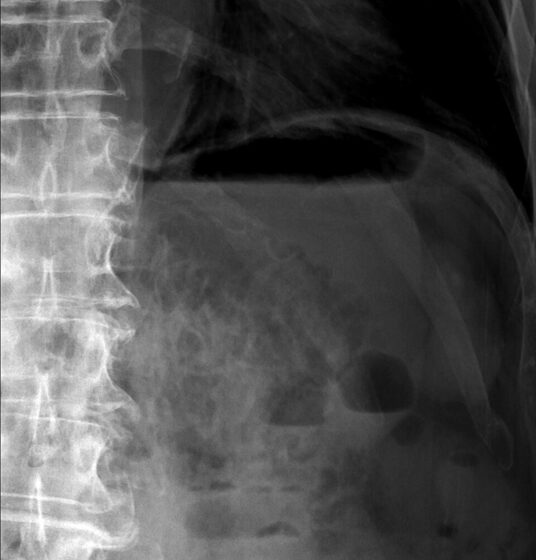
Necrotising enterocolitis — pneumatosis intestinalis (intramural gas) on neonatal AXR
Jto410 / CC BY-SA 3.0 — Wikimedia Commons
Investigations
AXR (serial — pneumatosis intestinalis, portal venous gas, free gas; the LATERAL DECUBITUS/cross-table film confirms free gas non-dependently); FBC (thrombocytopenia/neutropenia), CRP, blood gas (acidosis), blood cultures.
Management
Bowel rest (stop feeds) + NG + IV antibiotics; surgery for perforation/deterioration
- 1Stop enteral feeds (bowel rest), NG decompression, IV fluids/parenteral nutrition, broad-spectrum antibiotics, and serial AXRs. Neonatal/surgical involvement.Gate: FREE intraperitoneal gas = PERFORATION → surgery; on an equivocal supine film, a LATERAL DECUBITUS/cross-table lateral confirms free gas by showing it rise to the NON-DEPENDENT side — distinguishing perforation (free gas) from NEC's intramural pneumatosis
- 2Surgery (resection of necrotic bowel ± stoma, or primary peritoneal drain in the tiny/unstable infant) for perforation or deterioration; long-term: strictures, short-bowel syndrome. (Full neonatal teaching: child health.)
Key points
Preterm neonate + feed intolerance + distension + bloody stools + PNEUMATOSIS on AXR = NEC. Free gas means it has PERFORATED — and the decubitus film clinches free gas by its non-dependent pooling (exactly the read that separates NEC from perforation). Bowel rest + antibiotics; surgery for perforation.
Monitor & prognosis
Serial AXR/gas/platelets; surgical threshold.
Significant morbidity/mortality in preterms; strictures/short bowel survivors.
Source: BAPM/RCPCH; cross-ref child_health (neonatal)