Malaria
Plasmodium (falciparum most dangerous; vivax/ovale/malariae/knowlesi) — Anopheles mosquito
Overview
A protozoan infection transmitted by the Anopheles mosquito, and the most important diagnosis to consider in any febrile returning traveller. Plasmodium falciparum causes the severe, potentially fatal disease; vivax and ovale form dormant liver hypnozoites that cause relapse. Diagnosis is by thick and thin blood films (×3). Severe falciparum malaria is a medical emergency treated with IV artesunate; uncomplicated falciparum with an oral artemisinin-combination therapy (ACT).
Recognise
- Fever (often cyclical), rigors, headache, myalgia, malaise in a traveller returning from an endemic area — symptoms can start months later; anaemia, jaundice, splenomegaly, thrombocytopenia
- SEVERE falciparum: impaired consciousness/cerebral malaria, seizures, hypoglycaemia, acidosis, AKI, ARDS, DIC, haemoglobinuria ('blackwater fever'), parasitaemia >2%, shock
- Vivax/ovale: dormant liver HYPNOZOITES → relapse (need eradication with primaquine after G6PD testing)
Red flags
- Severe/complicated falciparum malaria (cerebral, hypoglycaemia, acidosis, AKI, high parasitaemia) → medical EMERGENCY → IV artesunate + critical care
- ALWAYS consider malaria in a febrile returning traveller — a missed diagnosis can be rapidly fatal
Differentials & how to tell them apart
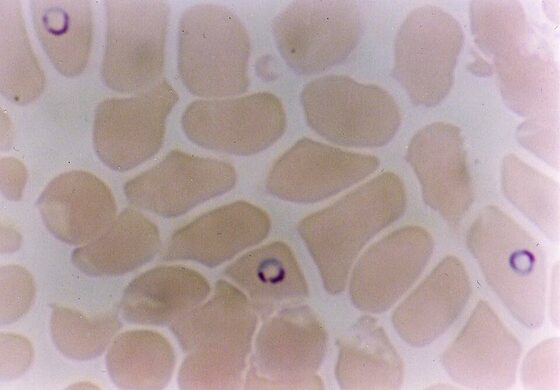
Plasmodium falciparum within red blood cells (blood film)
Ernst Hempelmann / Public domain — Wikimedia Commons
Investigations
THICK and THIN blood films (thick = detect parasites; thin = species + parasitaemia %) — repeat ×3 over 48 h before excluding; rapid antigen tests as adjunct; FBC (anaemia/thrombocytopenia), glucose, U&Es, LFTs, lactate, coagulation; assess severity criteria.
Management
Severe falciparum → IV artesunate; uncomplicated falciparum → oral ACT; vivax/ovale → +primaquine (check G6PD)
- 1In ANY febrile returning traveller, send thick and thin blood films (repeat ×3 over 48 h before excluding) and assess severity. Determine species and parasitaemia.Gate: Severe/complicated falciparum (cerebral malaria, hypoglycaemia, acidosis, AKI, parasitaemia >2%) is an EMERGENCY → IV artesunate + critical care, not oral therapy.
- 2Uncomplicated falciparum → oral ACT (artemether-lumefantrine); non-falciparum vivax/ovale → treat then give primaquine to eradicate hypnozoites (check G6PD first). Counsel travellers on ABCD prevention.
Key points
Febrile returning traveller = malaria until excluded → THICK & THIN films ×3. Falciparum is the killer: severe disease (cerebral/hypoglycaemia/acidosis/AKI/parasitaemia >2%) → IV ARTESUNATE emergency; uncomplicated → oral ACT. Vivax/ovale have liver HYPNOZOITES → add primaquine to prevent relapse (check G6PD first). Prevention = ABCD.
Monitor & prognosis
Parasitaemia/films, glucose/lactate/renal function in severe disease, response; G6PD before primaquine.
Uncomplicated malaria treated promptly does well; severe falciparum has significant mortality without rapid IV artesunate.
Source: UK malaria treatment guidelines; cross-ref haematology (G6PD)