Zoonotic infections & Lyme disease
Infections transmitted from animals — Lyme (Borrelia, ticks); also leptospirosis, brucellosis, Q fever, rabies, etc.
Overview
Infections transmitted from animals or their vectors, where the EXPOSURE HISTORY is the diagnostic key. Lyme disease (Borrelia burgdorferi, from Ixodes tick bites) is the headline — erythema migrans is diagnostic and treated with doxycycline. Other examinable zoonoses include leptospirosis (fresh water/rats), brucellosis (unpasteurised dairy/livestock), Q fever (farm animals), rabies (animal bite) and cat-scratch disease — each pointed to by occupational, recreational or travel exposure.
Recognise
- LYME: ERYTHEMA MIGRANS (expanding 'bull's-eye' rash) after a tick bite (rural/woodland exposure); later — facial palsy, meningitis, carditis (heart block), arthritis
- Leptospirosis (Weil's): fever + jaundice + AKI + conjunctival suffusion after fresh-water/rat exposure; brucellosis: undulant fever, sweats, back pain (unpasteurised dairy/farm)
- Q fever (Coxiella, farm animals); rabies (animal bite — hydrophobia, fatal once symptomatic → post-exposure prophylaxis); cat-scratch disease (Bartonella — regional lymphadenopathy)
Red flags
- Lyme carditis (heart block) or neuroborreliosis → specialist treatment (IV ceftriaxone)
- Rabies-risk exposure (bite in/from an endemic area) → urgent post-exposure prophylaxis (wound care + vaccine ± immunoglobulin) — fatal once symptomatic
Differentials & how to tell them apart
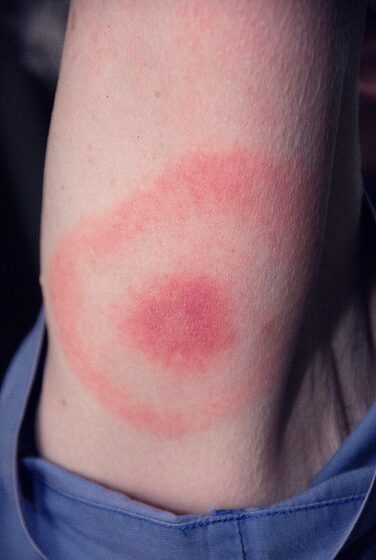
Erythema migrans — the 'bull's-eye' rash of Lyme disease
James Gathany, CDC / Public domain — Wikimedia Commons
Investigations
EXPOSURE history is central. Lyme: erythema migrans is a CLINICAL diagnosis (treat without testing); otherwise serology (ELISA → immunoblot). Leptospirosis/brucellosis/Q fever: serology/culture + the exposure. Rabies risk: assess the bite/animal/region for post-exposure prophylaxis.
Management
Lyme (erythema migrans) → doxycycline (clinical diagnosis); other zoonoses → exposure-targeted antibiotics
- 1Take the EXPOSURE history (ticks/woodland, fresh water, livestock/dairy, animal bites, travel). Lyme disease with erythema migrans is a CLINICAL diagnosis → treat with doxycycline without waiting for serology.Gate: Lyme carditis (heart block) or neuroborreliosis → IV ceftriaxone; a rabies-risk bite → urgent post-exposure prophylaxis (wound care + vaccine ± immunoglobulin) — rabies is fatal once symptomatic.
- 2For non-Lyme zoonoses, treat with exposure-targeted antibiotics (leptospirosis → doxycycline/penicillin; brucellosis → doxycycline + rifampicin; Q fever → doxycycline); serology confirms where the rash isn't diagnostic.
Key points
Exposure history is the key. LYME (Ixodes tick, woodland) → ERYTHEMA MIGRANS (bull's-eye) is a CLINICAL diagnosis → doxycycline (NG95); carditis/neuroborreliosis → IV ceftriaxone. Leptospirosis (Weil's: fever+jaundice+AKI, fresh water/rats), brucellosis (unpasteurised dairy), Q fever (farm). Rabies bite → urgent post-exposure prophylaxis (fatal once symptomatic).
Monitor & prognosis
Response to treatment, complications (Lyme carditis/arthritis), exposure-specific follow-up.
Lyme excellent with early doxycycline; rabies fatal once symptomatic (prevented by prompt PEP).
Source: NICE NG95 (Lyme); UKHSA zoonoses; cross-ref cardiovascular (heart block), neurology (facial palsy)