Osteoarthritis
Degenerative 'wear-and-repair' joint disease — cartilage loss + subchondral bone change
Overview
The commonest joint disease: progressive loss of articular cartilage with subchondral bone change, osteophytes and low-grade inflammation. It is a clinical diagnosis in those over 45 with activity-related joint pain and no prolonged morning stiffness. Management is core (exercise, weight loss, education) plus analgesia, with joint replacement for end-stage disease.
Recognise
- Activity-related joint pain, relieved by rest; stiffness <30 min after rest ('gelling'); commonly knees, hips, hands, spine, first CMC
- Hand OA: Heberden (DIP) and Bouchard (PIP) nodes, squaring of the thumb base
- X-ray (LOSS): Loss of joint space, Osteophytes, Subchondral Sclerosis, Subchondral cysts
Red flags
- Rest/night pain, systemic symptoms, or a hot swollen joint → reconsider inflammatory/septic/malignant cause
- Rapidly progressive hip OA → exclude other pathology
Differentials & how to tell them apart
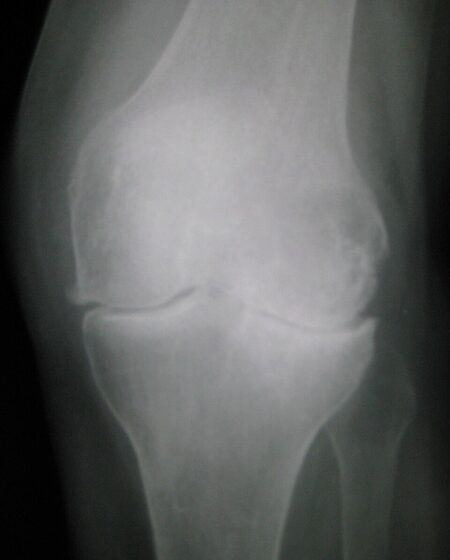
Osteoarthritis of the knee — joint-space loss, osteophytes and subchondral sclerosis (X-ray)
James Heilman, MD / CC BY-SA 4.0 — Wikimedia Commons
Investigations
Clinical diagnosis (NICE) if ≥45 with activity-related pain and no prolonged morning stiffness — no investigations needed. X-ray (LOSS changes) only if doubt or pre-operative; inflammatory markers normal (helps exclude inflammatory arthritis).
Management
Core exercise + weight loss + topical/oral NSAID; arthroplasty for end-stage disease
- 1Diagnose clinically in over-45s with activity-related pain and no prolonged morning stiffness. Core treatment for everyone = therapeutic exercise, weight loss and education. Add a topical NSAID (knee/hand), then an oral NSAID with a PPI.Gate: Rest/night pain, prolonged morning stiffness or a hot joint → reconsider an inflammatory, septic or malignant cause rather than OA.
- 2Intra-articular corticosteroid for flares; refer for joint replacement when symptoms and function are not controlled by conservative therapy.
Key points
Over-45, activity-related pain, stiffness <30 min, Heberden/Bouchard nodes, X-ray LOSS = osteoarthritis → exercise + weight loss (core) + topical/oral NSAID; replace end-stage joints. NICE de-emphasises paracetamol. Inflammatory markers are normal.
Monitor & prognosis
Function/pain, weight, NSAID tolerability; arthroplasty outcomes.
Slowly progressive; exercise and joint replacement give good functional outcomes.
Source: NICE NG226 (osteoarthritis)