Pseudogout (CPPD)
Calcium pyrophosphate dihydrate crystal deposition → acute and chronic arthritis
Overview
Acute or chronic arthritis from calcium pyrophosphate dihydrate (CPPD) crystal deposition, typically in larger joints (knee, wrist) of older people. Aspiration shows positively birefringent rhomboid crystals; X-ray shows chondrocalcinosis (cartilage calcification). It can be precipitated by intercurrent illness and is associated with metabolic conditions (haemochromatosis, hyperparathyroidism).
Recognise
- Acute hot, swollen joint — most often KNEE or wrist — in an older patient; may be precipitated by illness/surgery
- Chondrocalcinosis (linear cartilage calcification) on X-ray; chronic CPPD can resemble osteoarthritis
- Look for an underlying metabolic cause if young/florid: haemochromatosis, hyperparathyroidism, hypomagnesaemia, hypophosphatasia
Red flags
- Exclude SEPTIC arthritis in any acute hot joint by aspiration
- Florid/young-onset disease → screen for haemochromatosis/hyperparathyroidism
Differentials & how to tell them apart
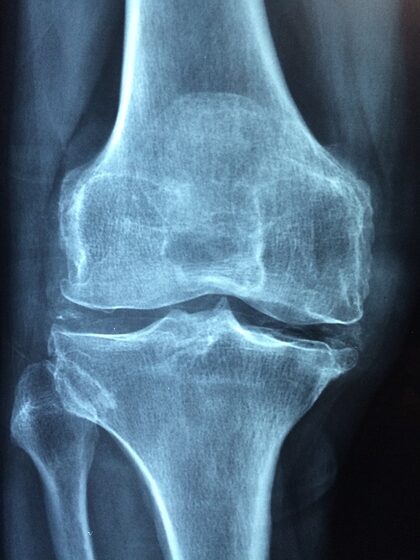
Chondrocalcinosis — calcification of knee cartilage (X-ray)
Taokinesis / CC0 — Wikimedia Commons
Investigations
Joint aspiration and polarised microscopy (POSITIVELY birefringent rhomboid CPPD crystals; exclude sepsis); X-ray (chondrocalcinosis); ferritin/Ca/PTH/Mg in young or florid disease.
Management
Aspirate to exclude sepsis → NSAID/colchicine/intra-articular steroid
- 1Aspirate the joint to confirm positively birefringent rhomboid crystals and exclude septic arthritis. Treat the acute attack with an NSAID, colchicine or a corticosteroid (often intra-articular).Gate: Young or florid/recurrent CPPD → investigate for an underlying metabolic cause (haemochromatosis, hyperparathyroidism, hypomagnesaemia).
- 2Manage recurrent attacks symptomatically (no urate-equivalent therapy) and treat any identified metabolic disorder.
Key points
Acute hot KNEE/wrist in an older patient + positively birefringent rhomboid crystals + chondrocalcinosis on X-ray = pseudogout (CPPD). Exclude sepsis; treat like acute gout. Young/florid disease → screen for haemochromatosis and hyperparathyroidism.
Monitor & prognosis
Attack frequency; metabolic screen results.
Acute attacks self-limit; chronic CPPD causes a degenerative arthropathy.
Source: NICE CKS (CPPD/pseudogout)