Rheumatoid arthritis
Chronic autoimmune symmetrical inflammatory polyarthritis (anti-CCP / rheumatoid factor)
Overview
A chronic, symmetrical, deforming inflammatory polyarthritis driven by autoimmune synovitis, with extra-articular features. Early diagnosis and early DMARD therapy (treat-to-target) prevent joint destruction. Anti-CCP is the most specific antibody; the small joints of the hands and feet are affected first, with morning stiffness lasting over an hour.
Recognise
- Symmetrical pain, swelling and early-morning stiffness (>1 h) of the small joints — MCPs, PIPs, wrists, MTPs (DIPs spared)
- Late deformities: ulnar deviation, swan-neck, boutonnière, Z-thumb; rheumatoid nodules
- Extra-articular: nodules, ILD, pleural/pericardial effusions, scleritis/episcleritis, Felty syndrome (RA + splenomegaly + neutropenia), AA amyloid, carpal tunnel
Red flags
- Atlanto-axial subluxation (neck instability) — caution before intubation/anaesthesia; cord compression
- Septic arthritis can complicate an RA joint — a single hot swollen joint out of keeping = aspirate
Differentials & how to tell them apart
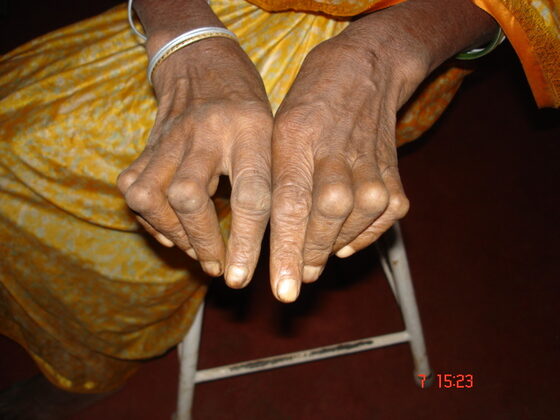
Rheumatoid arthritis — ulnar deviation and small-joint deformity of the hands
Prashanthns / CC BY-SA 3.0 — Wikimedia Commons
Investigations
Anti-CCP (most specific) and rheumatoid factor; raised ESR/CRP; X-rays (soft-tissue swelling, periarticular osteopenia, joint-space narrowing, marginal erosions, deformity); ultrasound/MRI for early synovitis; baseline FBC/U&E/LFTs before DMARDs.
Management
Methotrexate (first-line DMARD) + folic acid, treat-to-target, with a bridging steroid
- 1Refer early to rheumatology. Start a conventional DMARD as soon as diagnosis is made — methotrexate first-line with folic acid — and treat-to-target (escalate to control disease activity). Use a short bridging corticosteroid for flares.Gate: Before anti-TNF/biologic therapy, SCREEN for latent TB and hepatitis B/C (reactivation risk); methotrexate is contraindicated in pregnancy and needs the trimethoprim interaction avoided.
- 2Inadequate response to ≥2 conventional DMARDs → biologic or targeted synthetic DMARD (anti-TNF, rituximab, IL-6 or JAK inhibitor). MDT: physio/OT, surgery for severe joint damage.
Key points
Symmetrical small-joint synovitis with >1 h morning stiffness + anti-CCP/RF + marginal erosions = RA → early methotrexate, treat-to-target. Screen TB/hepatitis before anti-TNF. Watch atlanto-axial instability pre-anaesthesia and a single hot joint (septic arthritis).
Monitor & prognosis
Disease activity (DAS28), FBC/LFTs on methotrexate, CXR for ILD; annual CV risk (RA raises it).
Early DMARD therapy markedly improves outcomes; untreated disease causes irreversible joint destruction.
Source: NICE NG100 (rheumatoid arthritis)