Acute angle-closure glaucoma
Pupillary-block closure of the drainage angle → acute IOP rise (emergency)
Overview
A sudden rise in intraocular pressure when the iris blocks the trabecular drainage angle (pupillary block). An ophthalmic emergency presenting with a painful red eye, haloes, a hazy cornea and a fixed mid-dilated oval pupil, often with nausea and vomiting. Risk factors: hypermetropia, age, female sex, dilation (dark rooms, mydriatics, anticholinergics).
Recognise
- Acute severe eye pain and headache, blurred vision with HALOES around lights, nausea/vomiting
- Red eye with a hazy/cloudy cornea, a fixed mid-dilated oval pupil, and a hard ('stony') globe
- Precipitants: dim light, pupil-dilating drugs (mydriatics, anticholinergics, sympathomimetics, TCAs), hypermetropic (long-sighted) shallow-anterior-chamber eyes
Red flags
- Painful red eye + haloes + nausea + fixed mid-dilated pupil = AACG — sight-threatening, refer immediately
- Bilateral risk: treat the fellow eye prophylactically (laser iridotomy)
Differentials & how to tell them apart
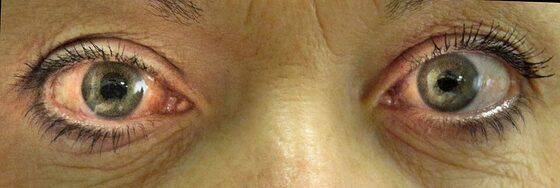
Acute angle-closure glaucoma — red eye, hazy cornea, mid-dilated pupil
James Heilman, MD / CC BY-SA 3.0 — Wikimedia Commons
Investigations
Tonometry (IOP often 40–80 mmHg), gonioscopy (closed angle), slit-lamp (shallow AC, corneal oedema). Diagnosis is clinical/urgent.
Management
Emergency referral + IOP-lowering (pilocarpine + acetazolamide); definitive = laser iridotomy
- 1Admit/refer immediately for same-day ophthalmology. If admission is delayed, start emergency treatment: lie the patient flat (face up, no pillow), pilocarpine drops (2% blue/4% brown eyes), acetazolamide 500 mg, analgesia and an antiemetic.Gate: Pilocarpine works only once the iris sphincter is not ischaemic — at very high IOP the pupil may not respond until pressure is first lowered (acetazolamide/topical agents); avoid drugs that dilate the pupil
- 2Secondary care: IV acetazolamide + topical agents (beta-blocker, pilocarpine, steroid) to break the attack, then DEFINITIVE peripheral laser iridotomy to both eyes (the fellow eye is at risk); lens extraction/iridoplasty in some.
Key points
Painful red eye + haloes + vomiting + fixed mid-dilated pupil in a long-sighted older person = AACG. Treat both eyes — the fellow eye is anatomically primed to close.
Monitor & prognosis
IOP response; lifelong glaucoma surveillance after iridotomy.
Good if treated within hours; delay causes permanent optic-nerve damage.
Source: NICE CKS Glaucoma (RCOphth 2022; NICE NG81)