Age-related macular degeneration
Degeneration of the central macula (dry/atrophic; wet/neovascular)
Overview
Degeneration of the central macula and the leading cause of central visual loss in older people. Dry (atrophic) AMD is gradual, with drusen and geographic atrophy; wet (neovascular) AMD involves choroidal neovascularisation with rapid central distortion and is treated with intravitreal anti-VEGF. Central vision is lost; peripheral/navigational vision is preserved.
Recognise
- Gradual loss of CENTRAL vision, difficulty reading/recognising faces; metamorphopsia (straight lines look wavy — Amsler grid)
- Dry: drusen and pigmentary changes, then geographic atrophy (slow); Wet: rapid central distortion/scotoma, haemorrhage/exudate at the macula
- Central scotoma with preserved peripheral vision; risk factors: age, smoking, family history, hypertension
Red flags
- Sudden central distortion/new scotoma → suspected WET AMD: refer to be seen urgently (within days) for anti-VEGF — the window to preserve vision is short
- New symptoms in the second eye → urgent same as above
Differentials & how to tell them apart
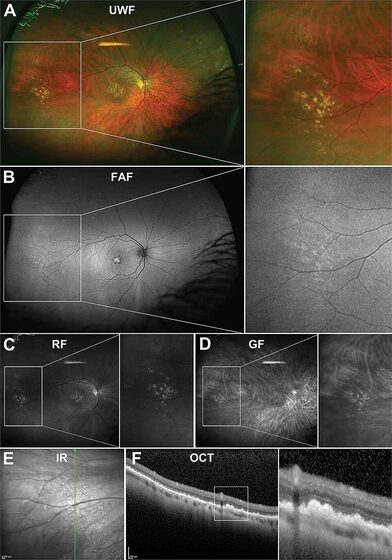
Age-related macular degeneration — macular drusen
Rene Cheung, Angelica Ly / CC BY 4.0 — Wikimedia Commons
Investigations
Visual acuity + Amsler grid; dilated fundoscopy; OCT (the key test — fluid/neovascular membrane); fluorescein/OCT-angiography to confirm wet AMD.
Management
Wet AMD → urgent intravitreal anti-VEGF; dry AMD → AREDS2 + lifestyle, low-vision support
- 1Confirm with OCT. Wet AMD: refer to the macular service to be seen urgently (within days). Dry AMD: AREDS2 supplements for intermediate/advanced disease, smoking cessation, Amsler self-monitoring and low-vision support.Gate: Sudden central distortion = suspected WET AMD → see urgently for anti-VEGF; delay loses central vision permanently
- 2Wet AMD: ongoing intravitreal anti-VEGF per protocol. All: certify visual impairment when eligible, low-vision rehabilitation, treat associated depression.
Key points
Central distortion (wavy lines on the Amsler grid) + drusen = AMD. Wet AMD is the urgent, treatable form — sudden distortion needs anti-VEGF fast. Peripheral vision (and mobility) is retained.
Monitor & prognosis
Amsler grid at home; OCT-guided injection intervals.
Wet AMD often stabilised with prompt anti-VEGF; dry AMD progresses slowly.
Source: NICE CKS AMD; NICE NG82; RCOphth