Diabetic retinopathy
Microvascular retinal damage from chronic hyperglycaemia (non-proliferative → proliferative; maculopathy)
Overview
Microvascular retinal damage from chronic hyperglycaemia — the leading cause of blindness in the working-age population. Graded non-proliferative (microaneurysms, dot-blot haemorrhages, exudates, cotton-wool spots) → proliferative (retinal neovascularisation, risking vitreous haemorrhage and tractional detachment). Diabetic maculopathy (macular oedema) is the main cause of vision loss. Annual screening; treat with laser/anti-VEGF and glycaemic/BP control.
Recognise
- Often asymptomatic until advanced (hence screening); blurring, floaters or sudden loss (vitreous haemorrhage) late
- Non-proliferative: microaneurysms, dot-blot haemorrhages, hard exudates, cotton-wool spots, venous beading
- Proliferative: new vessels at the disc/elsewhere (NVD/NVE) → vitreous haemorrhage, tractional detachment, rubeotic glaucoma; maculopathy = exudates/oedema near the fovea
Red flags
- Proliferative disease (neovascularisation) → urgent panretinal photocoagulation (blindness risk)
- Sudden visual loss → vitreous haemorrhage or tractional detachment
- Sight-threatening maculopathy → anti-VEGF
Differentials & how to tell them apart
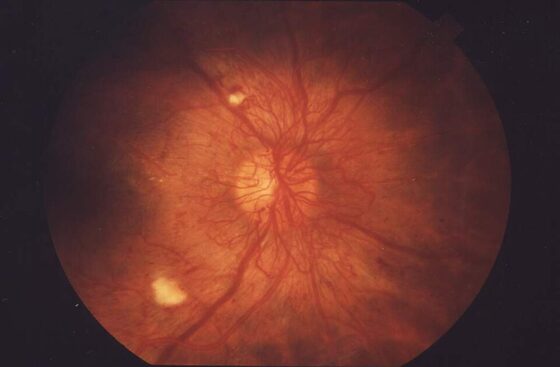
Proliferative diabetic retinopathy — neovascularisation and haemorrhages
National Eye Institute / Public domain — Wikimedia Commons
Investigations
Annual digital retinal photography screening (dilated); OCT for macular oedema; fluorescein angiography for ischaemia/neovascularisation. HbA1c, BP, lipids, renal function.
Management
Optimise glucose/BP/lipids + screening; laser/anti-VEGF for sight-threatening disease
- 1Annual retinal screening for all people with diabetes; optimise glycaemic, BP and lipid control. Refer to ophthalmology per screening grade.Gate: PROLIFERATIVE retinopathy (neovascularisation) needs panretinal photocoagulation; sight-threatening MACULOPATHY/macular oedema needs anti-VEGF — these are the two sight-saving interventions
- 2Proliferative disease → panretinal photocoagulation ± anti-VEGF; diabetic macular oedema → intravitreal anti-VEGF (or steroid); vitrectomy for non-clearing vitreous haemorrhage/tractional detachment.
Key points
Microaneurysms are the earliest sign; neovascularisation (proliferative) and macular oedema are what blind. Screening + control + timely laser/anti-VEGF. (Cross-references the Endocrine page — a content-map item there.)
Monitor & prognosis
Annual screening; tighter follow-up by grade.
Largely preventable with control and screening; advanced disease threatens sight.
Source: NICE NG (diabetes); Diabetic Eye Screening Programme; RCOphth