Hordeolum (stye)
Acute focal infection of a lid gland (external: lash follicle/Zeis-Moll; internal: meibomian gland)
Overview
An acute, painful, localised staphylococcal infection of an eyelid gland. External hordeolum (common stye) points at the lash line (gland of Zeis/Moll); internal hordeolum is an infected meibomian gland pointing on the inner lid. Self-limiting — warm compresses, NOT antibiotics.
Recognise
- Acute tender red swelling at the lid margin, pointing externally (lash line) or internally (tarsal surface)
- Localised, comes to a head and discharges; may recur and is associated with blepharitis
- An internal hordeolum can evolve into a chalazion once the acute infection settles
Red flags
- Spreading lid erythema/oedema, proptosis, painful or restricted eye movements, fever → periorbital/orbital cellulitis — admit
Differentials & how to tell them apart
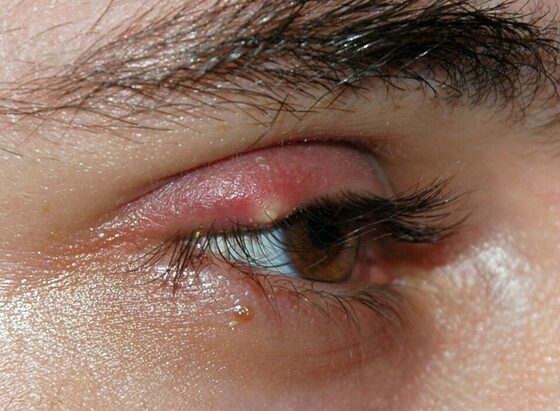
External stye — tender lesion pointing at the lash line
Andre Riemann / Public domain — Wikimedia Commons
Investigations
Clinical. No investigation.
Management
Warm compresses (and epilate the lash / incise-drain an external pointing stye if needed)
- 1Reassure (self-limiting). Warm compress 5–10 min 2–4 times daily; avoid eye make-up/contact lenses; do not squeeze. For a painful pointing external stye, epilate the affected lash or incise-and-drain with a sterile needle if expertise allows.Gate: Emergency admission if periorbital/orbital cellulitis; same-day ophthalmology if corneal symptoms, rapid visual loss or a red painful eye — and refer on a cancer pathway if eyelid malignancy is suspected
- 2Very large/severe/atypical, recurrent, or diagnostic uncertainty → refer to ophthalmology.
Key points
Painful + acute = stye; painless + chronic firm nodule = chalazion. Both are managed with warm compresses first.
Monitor & prognosis
Resolves over days; recurrent styes → treat underlying blepharitis.
Excellent; self-limiting.
Source: NICE CKS Styes (hordeola)