Hypertensive retinopathy
Retinal vascular changes from chronic/accelerated hypertension
Overview
Retinal microvascular changes caused by hypertension, graded (Keith-Wagener-Barker) from arteriolar narrowing through AV nipping and flame haemorrhages/cotton-wool spots to papilloedema (malignant/accelerated hypertension). Usually asymptomatic; finding it should prompt BP assessment and, with papilloedema, urgent treatment.
Recognise
- Usually asymptomatic; found on fundoscopy/screening
- Grade 1: arteriolar narrowing/silver-copper wiring · Grade 2: AV nipping · Grade 3: flame haemorrhages, cotton-wool spots, hard exudates (macular star) · Grade 4: + papilloedema
- Accelerated/malignant hypertension: very high BP + papilloedema/retinal haemorrhages → emergency
Red flags
- Papilloedema/retinal haemorrhages with very high BP (≥180/120) = malignant hypertension → same-day assessment for end-organ damage
- Headache, visual symptoms with grade 3–4 changes → urgent
Differentials & how to tell them apart
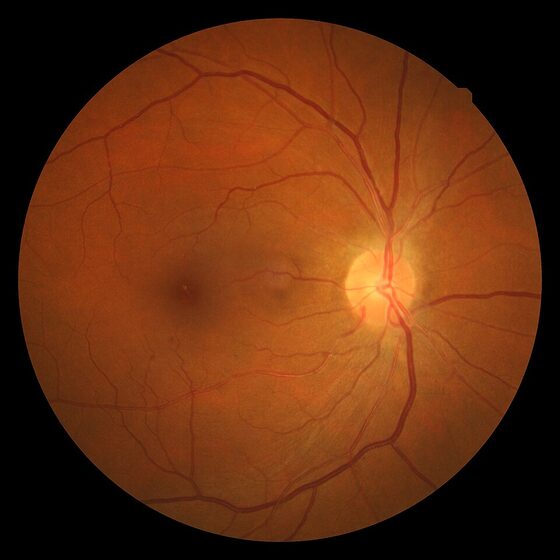
Hypertensive retinopathy — AV nipping, haemorrhages, cotton-wool spots
Frank Wood / CC BY 3.0 — Wikimedia Commons
Investigations
Fundoscopy/retinal photography; measure BP and assess end-organ damage (urinalysis, renal function, ECG); investigate secondary hypertension if young/severe.
Management
Control blood pressure (urgent if malignant hypertension with papilloedema)
- 1Measure and manage BP per the hypertension pathway; assess for other end-organ damage.Gate: Grade 4 (papilloedema) with very high BP = malignant/accelerated hypertension → SAME-DAY assessment and controlled BP reduction, not routine titration
- 2Investigate secondary causes if young/resistant; ongoing BP control reverses early changes.
Key points
AV nipping and arteriolar narrowing are the chronic signs; papilloedema with very high BP is the emergency. The retina is a window onto systemic vascular damage.
Monitor & prognosis
BP control and end-organ surveillance.
Early changes reversible; malignant hypertension is dangerous.
Source: NICE CKS Hypertension; Keith-Wagener-Barker grading