Retinitis pigmentosa
Inherited progressive rod-cone photoreceptor dystrophy
Overview
An inherited (often autosomal-recessive/dominant/X-linked) progressive degeneration of photoreceptors — rods first. Presents with childhood/young-adult night blindness and progressive peripheral (tunnel) field loss. Classic fundus: bone-spicule pigmentation, attenuated vessels and a waxy pale disc. May be syndromic (Usher = + deafness; Bardet-Biedl).
Recognise
- NIGHT BLINDNESS (nyctalopia) and progressive PERIPHERAL field loss (tunnel vision), usually from childhood/teens
- Fundus triad: bone-spicule peripheral pigmentation, arteriolar attenuation, waxy pale optic disc
- Syndromic associations: Usher syndrome (sensorineural deafness), Bardet-Biedl, Refsum disease; positive family history
Red flags
- Associated hearing loss (Usher) → audiology; counsel re progressive sight loss and registration
Differentials & how to tell them apart
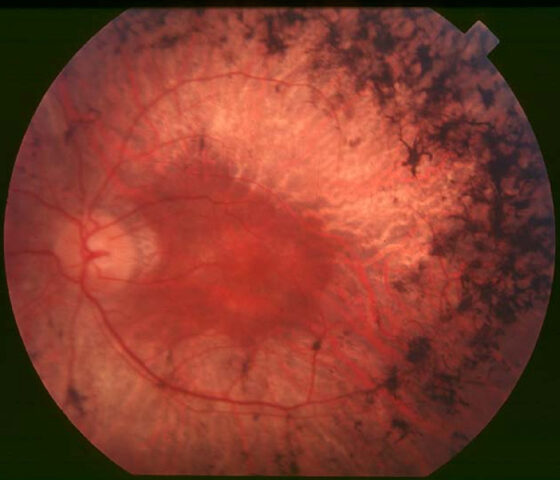
Retinitis pigmentosa — bone-spicule pigmentation and attenuated vessels
Christian Hamel / CC BY 2.0 — Wikimedia Commons
Investigations
Electroretinogram (reduced/extinguished — the key test), visual fields (constriction), OCT, genetic testing; screen for syndromic features.
Management
Genetic counselling + low-vision support; genotype-specific therapy where available
- 1Refer to a specialist genetic-eye service. Confirm with ERG/genetics, counsel about inheritance and prognosis, low-vision support and registration; screen for syndromic associations (hearing).Gate: Identify treatable/genotype-specific forms (e.g. RPE65-related disease eligible for gene therapy) and reversible mimics (vitamin A deficiency) before labelling it untreatable
- 2Low-vision rehabilitation, driving/occupational advice, genetic counselling; gene therapy in eligible genotypes; manage cataract/macular oedema complications.
Key points
Night blindness + tunnel vision + bone-spicule fundus = RP. The ERG confirms it. Always ask about hearing (Usher).
Monitor & prognosis
Serial fields/visual function; genetic and syndromic follow-up.
Slowly progressive; many retain central vision into mid-life.
Source: RCOphth; inherited retinal disease services