Subconjunctival haemorrhage
Rupture of a small subconjunctival vessel (spontaneous or Valsalva/anticoagulant-related)
Overview
A flat, painless, well-demarcated patch of blood under the conjunctiva from a ruptured vessel. Benign and self-limiting; the role of the clinician is to reassure and to check for the few meaningful associations (hypertension, anticoagulation, trauma; bilateral/recurrent → bleeding tendency).
Recognise
- Painless, sudden, bright-red flat patch with normal vision and a white cornea
- No discharge, no photophobia; often noticed by someone else or in the mirror
- Triggers: Valsalva (cough/sneeze/straining), trauma, anticoagulants, hypertension
Red flags
- Following trauma with no posterior border visible, or with reduced vision/proptosis → exclude globe rupture/orbital injury (refer)
- Recurrent/spontaneous bilateral haemorrhages → check clotting/platelets
Differentials & how to tell them apart
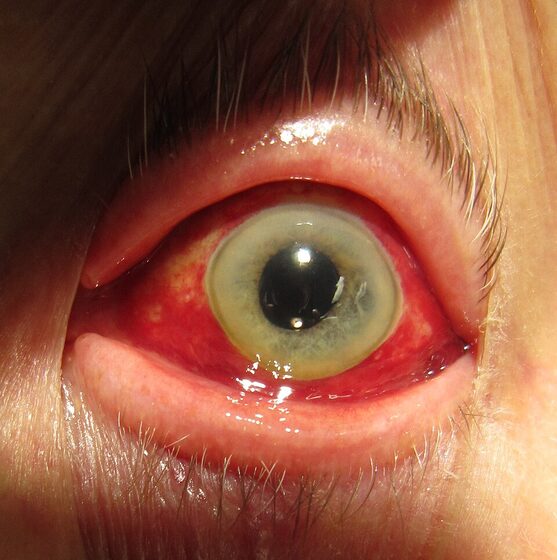
Subconjunctival haemorrhage — flat, well-demarcated blood under the conjunctiva
James Heilman, MD / CC BY-SA 3.0 — Wikimedia Commons
Investigations
Clinical. Check BP; check INR if on warfarin; clotting screen only if recurrent/bilateral or other bleeding.
Management
Reassurance — resolves in 1–2 weeks; treat hypertension/anticoagulation if relevant
- 1Reassure: clears spontaneously over 1–2 weeks (changes colour like a bruise). Measure BP and treat if raised; check INR if on warfarin. Cold compress if uncomfortable.Gate: Refer if it followed significant trauma (exclude globe rupture / no visible posterior margin), or if there is reduced vision, pain or photophobia (then it is not a simple SCH)
- 2Recurrent/spontaneous → investigate for a bleeding diathesis.
Key points
Painless, vision normal, white-and-quiet cornea, blood is flat and superficial = benign. The trap is the trauma case hiding a ruptured globe.
Monitor & prognosis
Self-resolves; no follow-up unless recurrent.
Excellent.
Source: NICE CKS Red eye