Thyroid eye disease (Graves orbitopathy)
Autoimmune orbital inflammation associated with Graves disease
Overview
Autoimmune inflammation and expansion of the orbital fat and extraocular muscles associated with Graves disease (can occur euthyroid/hypothyroid). Causes proptosis, lid retraction, restrictive diplopia and ocular-surface exposure; the sight-threatening complication is compressive (dysthyroid) optic neuropathy. Smoking markedly worsens it. Managed with risk-factor control, selenium, steroids/immunotherapy and orbital decompression.
Recognise
- Bilateral (often asymmetric) proptosis (exophthalmos), LID RETRACTION and lid lag, grittiness and watering
- Restrictive DIPLOPIA from enlarged muscles (inferior/medial rectus); conjunctival injection over the muscle insertions; exposure keratopathy
- Features of Graves (goitre, tremor, weight loss, AF); smoking is a major risk factor
Red flags
- Reduced colour vision, an RAPD, or reduced acuity → compressive (dysthyroid) OPTIC NEUROPATHY — urgent (sight-threatening)
- Corneal exposure/ulcer from severe proptosis → urgent corneal protection
Differentials & how to tell them apart
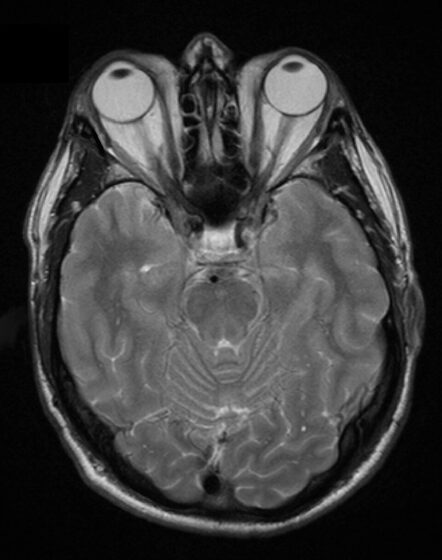
Thyroid eye disease — MRI showing enlarged extraocular muscles
Huy A Tran & Glenn EM Reeves / CC BY-SA 4.0 — Wikimedia Commons
Investigations
Thyroid function + TSH-receptor antibodies; assess proptosis (exophthalmometry), eye movements, colour vision, acuity, pupils; CT/MRI orbits (muscle enlargement sparing tendons); visual fields if optic neuropathy suspected.
Management
Stop smoking + restore euthyroidism + lubricants; immunosuppression/decompression for active/sight-threatening disease
- 1Restore and maintain euthyroidism, STOP smoking, ocular lubricants for exposure, selenium for mild active disease. Refer to a TED/orbital service for grading.Gate: Reduced colour vision, RAPD or reduced acuity = compressive OPTIC NEUROPATHY → urgent high-dose steroids ± orbital DECOMPRESSION (sight-threatening), not routine management
- 2Moderate-to-severe active disease → IV methylprednisolone ± mycophenolate/teprotumumab/orbital radiotherapy; rehabilitative surgery (decompression → squint → lid) once inactive.
Key points
Proptosis + lid retraction + restrictive diplopia + Graves = thyroid eye disease; smoking is the worst accelerant. The emergency is dysthyroid optic neuropathy — colour vision and the RAPD are the warning signs. (Graves is a content-map Endocrine item — cross-referenced here for the orbital disease.)
Monitor & prognosis
Disease activity (CAS), colour vision/acuity; thyroid status; smoking.
Burns out over 1–3 years; residual proptosis/diplopia may need surgery.
Source: RCOphth/British Thyroid Association TED guidance; EUGOGO