Bladder cancer
Transitional cell (urothelial) carcinoma usually — smoking & occupational amines the key risks
Overview
Malignancy of the bladder, in the UK usually transitional cell (urothelial) carcinoma. The cardinal presentation is PAINLESS VISIBLE HAEMATURIA, which mandates urgent (2-week-wait) referral for cystoscopy. Smoking and occupational aromatic-amine exposure (dye/rubber industry) are major risks; schistosomiasis causes squamous-cell bladder cancer in endemic areas.
Recognise
- PAINLESS visible (macroscopic) haematuria — the classic presentation; also recurrent UTIs, storage LUTS, non-visible haematuria
- Risk factors: SMOKING (the big one), occupational aromatic amines (dye, rubber, leather), chronic inflammation/catheters; schistosomiasis → squamous-cell carcinoma
- Most are non-muscle-invasive at presentation; muscle-invasive disease is more aggressive
Red flags
- Visible haematuria (any age) → urgent 2-week-wait referral; non-visible haematuria with risk factors/age → refer per NICE NG12
- Muscle-invasive or metastatic disease → radical treatment
Differentials & how to tell them apart
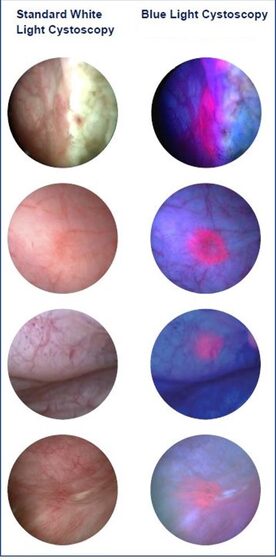
Bladder tumour seen at cystoscopy (white-light and blue-light)
Jecontributes / CC BY-SA 4.0 — Wikimedia Commons
Investigations
Flexible CYSTOSCOPY (the key diagnostic test) + urine cytology; CT urogram for upper-tract assessment/staging; TURBT for histology and depth (muscle-invasive vs not); bloods/renal function. Urgent referral per NICE NG12 for haematuria.
Management
Cystoscopy + TURBT; non-muscle-invasive → intravesical BCG/mitomycin; muscle-invasive → cystectomy/radiotherapy
- 1Painless visible haematuria → urgent 2-week-wait referral for flexible cystoscopy (+ urine cytology, CT urogram). TURBT gives histology and depth.Gate: The depth at TURBT splits management: non-muscle-invasive → intravesical therapy + surveillance; muscle-invasive → radical cystectomy/radiotherapy.
- 2Non-muscle-invasive → TURBT + intravesical BCG/mitomycin and surveillance cystoscopy; muscle-invasive → radical treatment ± neoadjuvant chemo; metastatic → systemic therapy. Stop smoking.
Key points
PAINLESS visible haematuria = bladder cancer until proven otherwise → urgent 2-week-wait cystoscopy. Smoking + aromatic amines (dye/rubber) are the risks; schistosomiasis → squamous-cell. Depth at TURBT decides treatment: non-muscle-invasive (intravesical BCG/mitomycin) vs muscle-invasive (cystectomy/radiotherapy).
Monitor & prognosis
Surveillance cystoscopy (recurrence), treatment response, renal function.
Non-muscle-invasive: good but recurs (lifelong surveillance); muscle-invasive/metastatic: worse.
Source: NICE NG2 (bladder cancer); NG12 (haematuria referral)