Polycystic kidney disease
Inherited (usually autosomal dominant, PKD1/PKD2) progressive renal cyst formation → enlarging kidneys, CKD
Overview
An inherited cystic kidney disease — most commonly autosomal dominant (ADPKD, PKD1/PKD2 mutations) — in which progressive cyst formation enlarges the kidneys and causes hypertension, haematuria, pain and progression to renal failure by middle age. The crucial extra-renal association is intracranial (berry) aneurysms → subarachnoid haemorrhage. Tolvaptan slows progression in selected patients.
Recognise
- Family history (autosomal dominant); hypertension (often early), loin pain, haematuria, recurrent UTIs/cyst infection, renal stones; bilateral flank masses (enlarged kidneys)
- Extra-renal: liver cysts, intracranial BERRY ANEURYSMS (subarachnoid haemorrhage), mitral valve prolapse, diverticular disease, abdominal wall hernias
- Progresses to ESRD typically by the 5th–6th decade; ARPKD (recessive) presents in infancy
Red flags
- Sudden thunderclap headache → subarachnoid haemorrhage from a ruptured berry aneurysm → emergency
- Family history of SAH/aneurysm → consider screening (MR angiography)
Differentials & how to tell them apart
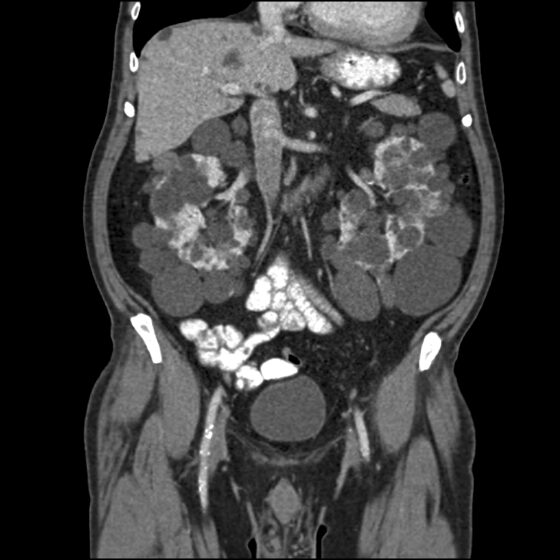
Autosomal dominant polycystic kidney disease — innumerable bilateral renal cysts (CT)
Steven Fruitsmaak / CC BY-SA 3.0 — Wikimedia Commons
Investigations
Renal ultrasound (multiple bilateral cysts; age-adjusted diagnostic criteria with family history); genetic testing if needed; BP, U&Es/eGFR; MR angiography to screen for intracranial aneurysms in selected patients (family history of SAH); liver imaging for cysts.
Management
BP control (ACEi/ARB) + tolvaptan in selected rapid progressors; manage complications/CKD
- 1Diagnose on ultrasound (bilateral cysts + family history); control BP tightly with an ACE inhibitor/ARB and manage complications (cyst infection/bleed, stones, pain).Gate: Thunderclap headache → CT for subarachnoid haemorrhage (ruptured berry aneurysm); a family history of SAH warrants MR-angiography screening.
- 2Tolvaptan for selected rapidly-progressing ADPKD (monitor LFTs); manage CKD complications and progress to dialysis/transplant at ESRD; offer genetic counselling.
Key points
Bilateral flank masses + hypertension + haematuria + family history = ADPKD → BP control (ACEi/ARB), tolvaptan in rapid progressors. The killer association is intracranial BERRY ANEURYSM → subarachnoid haemorrhage (thunderclap headache). Also liver cysts, MV prolapse, diverticular disease.
Monitor & prognosis
BP, eGFR trajectory, LFTs on tolvaptan, complication surveillance; aneurysm screening in selected patients.
Progressive to ESRD by middle age in most ADPKD; SAH is the catastrophic complication.
Source: NICE; UK Kidney Association; cross-ref neurology (SAH)