Potassium disorders
Hyperkalaemia (retention/shift/release) / hypokalaemia (loss/shift) — both arrhythmogenic
Overview
Disorders of plasma potassium, both potentially fatal through cardiac arrhythmia. Hyperkalaemia (AKI/CKD, ACEi/ARB/spironolactone, Addison's, rhabdomyolysis, acidosis) is the classic medical emergency with a defined ECG progression and a fixed treatment sequence. Hypokalaemia (GI/renal loss, diuretics, alkalosis, hyperaldosteronism) prolongs the QT and causes U waves.
Recognise
- Hyperkalaemia: often asymptomatic until arrhythmia; ECG progression — tall TENTED T waves → small/flat P waves → broad QRS → sine wave → VF/asystole
- Hypokalaemia: weakness, cramps, palpitations, constipation; ECG — flattened T waves, U waves, ST depression, long QT
- Causes — hyperK: AKI/CKD, K-sparing drugs (ACEi/ARB/spironolactone), Addison's, acidosis, rhabdomyolysis, haemolysed sample (pseudo); hypoK: D&V, diuretics, alkalosis, Conn's, Cushing's
Red flags
- Hyperkalaemia with ECG changes (or K ≥6.5) → EMERGENCY: IV calcium gluconate first (cardioprotection) then insulin-dextrose
- Severe hypokalaemia (<2.5 / arrhythmia) → cardiac-monitored IV replacement; replace magnesium too (won't correct otherwise)
Differentials & how to tell them apart
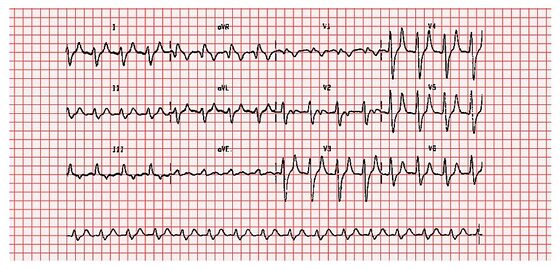
Hyperkalaemia — peaked (tented) T waves on the ECG
M. Rosengarten, CardioNetworks ECGpedia / CC BY-SA 3.0 — Wikimedia Commons
Investigations
U&Es (confirm — exclude a haemolysed/pseudohyperkalaemia sample), ECG (the key bedside test), VBG (acid-base), glucose; cause work-up — renal function, drugs, cortisol (Addison's), aldosterone/renin (Conn's), magnesium (with hypokalaemia).
Management
HyperK → calcium gluconate then insulin-dextrose; hypoK → KCl (+ magnesium)
- 1Get an ECG immediately. Hyperkalaemia with ECG changes (or K ≥6.5) → IV calcium gluconate FIRST (cardioprotection), then insulin + dextrose to shift potassium in (± salbutamol).Gate: Calcium gluconate protects the heart but does NOT lower potassium — you still need insulin-dextrose to shift it and treatment of the cause/binders/dialysis to remove it. Always exclude a haemolysed (pseudo) sample.
- 2Remove potassium from the body (treat cause, stop K-sparing drugs, binders, dialysis if refractory). Hypokalaemia → replace KCl at a safe rate AND replace magnesium (potassium won't correct without it).
Key points
Hyperkalaemia ECG: tall TENTED T waves → flat P → broad QRS → sine wave. Treatment ORDER: calcium gluconate (protects heart, doesn't lower K) → insulin-dextrose (shifts) → remove (binders/dialysis). Hypokalaemia: U waves, long QT — replace K AND magnesium. Exclude a haemolysed sample.
Monitor & prognosis
Serial K + ECG, glucose after insulin-dextrose, magnesium; renal function and the cause.
Excellent with prompt treatment; untreated extremes cause fatal arrhythmia.
Source: UK Kidney Association hyperkalaemia; Resus Council UK; cross-ref endocrine (Addison's/Conn's)