Bronchiectasis
Permanent abnormal bronchial dilatation from a cycle of infection and inflammation
Overview
Permanent, abnormal dilatation of the bronchi resulting from a vicious cycle of infection, inflammation and impaired mucociliary clearance. It presents with a chronic productive cough of large volumes of (often purulent) sputum and recurrent chest infections. HRCT (signet-ring sign, tramlines) is diagnostic. Causes include post-infective, cystic fibrosis, immunodeficiency, ABPA and ciliary dyskinesia; Pseudomonas colonisation is a key issue.
Recognise
- Chronic cough productive of LARGE volumes of (often purulent/khaki) sputum, recurrent chest infections, haemoptysis; coarse crackles, clubbing
- HRCT: bronchial dilatation — 'signet-ring' sign (airway wider than its vessel), tramline/cystic changes
- Causes: post-infective (whooping cough/TB/pneumonia), cystic fibrosis, immunodeficiency, ABPA (asthma + Aspergillus), primary ciliary dyskinesia (Kartagener), connective tissue disease
Red flags
- Massive haemoptysis → emergency (bronchial artery embolisation)
- Pseudomonas aeruginosa colonisation/exacerbation → tailored (often anti-pseudomonal) antibiotics; recurrent exacerbations
Differentials & how to tell them apart
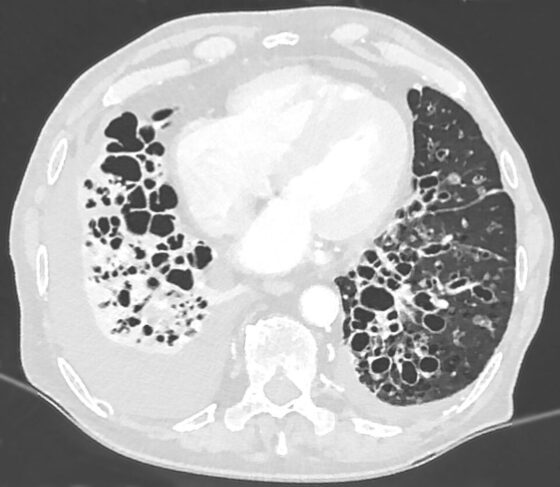
Bronchiectasis — dilated, thick-walled bronchi on CT
Hellerhoff / CC BY-SA 4.0 — Wikimedia Commons
Investigations
HRCT chest (diagnostic — bronchial dilatation, signet-ring/tramlines); sputum culture (organisms incl. Pseudomonas); spirometry (obstructive); investigate the cause — immunoglobulins, CF testing (sweat test/genetics), Aspergillus serology (ABPA), ciliary studies; FBC.
Management
Airway clearance physiotherapy + treat the cause + sputum-guided antibiotics for exacerbations
- 1Diagnose on HRCT (bronchial dilatation). Mainstay = airway-clearance physiotherapy plus identifying and treating the underlying cause (immunodeficiency, ABPA, CF, ciliary dyskinesia). Send sputum culture.Gate: Pseudomonas colonisation changes antibiotic choice (anti-pseudomonal cover); massive haemoptysis → emergency bronchial artery embolisation.
- 2Treat exacerbations promptly with sputum-guided (often longer) antibiotics; consider long-term azithromycin for frequent exacerbations; vaccines; surgery/embolisation for localised refractory disease or massive haemoptysis.
Key points
Chronic LARGE-volume purulent sputum + recurrent infections + clubbing + HRCT bronchial dilatation (signet-ring/tramlines) = bronchiectasis → airway clearance + treat the cause + sputum-guided antibiotics. Hunt the cause (CF, immunodeficiency, ABPA, ciliary dyskinesia). Pseudomonas colonisation matters; massive haemoptysis → embolisation.
Monitor & prognosis
Sputum/colonisation, exacerbation frequency, lung function, the underlying cause.
Chronic; airway clearance and prompt antibiotics control it; Pseudomonas/frequent exacerbations worsen it.
Source: NICE NG117 / BTS bronchiectasis