Interstitial lung disease & pulmonary fibrosis
Diffuse parenchymal lung disease → inflammation/fibrosis of the interstitium (restrictive, low DLCO)
Overview
A group of diffuse parenchymal lung diseases causing inflammation and/or fibrosis of the interstitium, with a RESTRICTIVE pattern and reduced gas transfer (DLCO). Idiopathic pulmonary fibrosis (IPF) is the commonest progressive form (basal/peripheral honeycombing, antifibrotics); others are drug-induced, connective-tissue-disease-associated, hypersensitivity pneumonitis, sarcoidosis and pneumoconioses. Progressive exertional breathlessness with fine crackles and clubbing is the picture.
Recognise
- Progressive exertional breathlessness, dry cough, fine bibasal 'velcro' inspiratory crackles, finger clubbing (IPF)
- Spirometry: RESTRICTIVE (FEV1/FVC normal/high, reduced FVC) with reduced gas transfer (DLCO); HRCT — reticulation, traction bronchiectasis, basal/subpleural HONEYCOMBING (UIP pattern in IPF)
- Causes: idiopathic (IPF), drugs (amiodarone, methotrexate, nitrofurantoin, bleomycin), connective tissue disease, hypersensitivity pneumonitis, sarcoidosis, asbestosis
Red flags
- Acute exacerbation of IPF (rapid deterioration) → high mortality, specialist care
- A new ILD on a drug (amiodarone/methotrexate/nitrofurantoin) → stop the culprit drug
Differentials & how to tell them apart
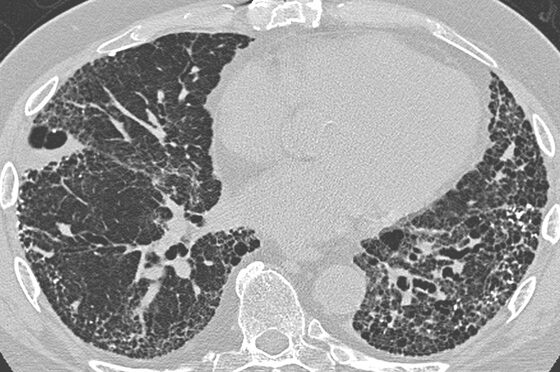
Usual interstitial pneumonia — peripheral/basal honeycombing on HRCT
Yale Rosen / CC BY-SA 2.0 — Wikimedia Commons
Investigations
Spirometry (restrictive) + DLCO (reduced); HRCT chest (pattern — UIP/honeycombing in IPF); autoimmune screen (connective-tissue disease), drug and occupational/exposure history; sometimes lung biopsy/bronchoalveolar lavage; MDT diagnosis.
Management
Treat/remove the cause; IPF → antifibrotics (pirfenidone/nintedanib); inflammatory ILD → immunosuppression
- 1Recognise a restrictive pattern with reduced DLCO and confirm with HRCT (UIP/honeycombing in IPF); take a careful drug, occupational and autoimmune history (MDT diagnosis).Gate: IPF does NOT respond to steroids (and immunosuppression may harm) → use antifibrotics; inflammatory/CTD-related ILD DOES respond to immunosuppression — distinguish them. Stop a culprit drug (amiodarone/methotrexate/nitrofurantoin).
- 2Treat the underlying cause; antifibrotics for IPF, immunosuppression for inflammatory ILD; supportive oxygen/rehab/vaccines; consider transplant in selected patients.
Key points
Progressive breathlessness + dry cough + fine 'velcro' basal crackles + clubbing + RESTRICTIVE spirometry/low DLCO + HRCT honeycombing = pulmonary fibrosis. IPF → ANTIFIBROTICS (pirfenidone/nintedanib); steroids don't help IPF (may harm) but DO help inflammatory/CTD-ILD. Always check drugs (amiodarone/methotrexate/nitrofurantoin/bleomycin).
Monitor & prognosis
FVC/DLCO trajectory, oxygenation, exacerbations; drug/CTD activity.
IPF progressive with poor prognosis (antifibrotics slow it); inflammatory ILDs better with treatment.
Source: NICE CG163 (IPF); ILD MDT