Lung cancer
Non-small-cell (adeno/squamous/large-cell) or small-cell carcinoma — smoking the dominant risk
Overview
A leading cause of cancer death, dominated by smoking. Split into non-small-cell (NSCLC — adenocarcinoma, squamous, large-cell) and small-cell (SCLC — aggressive, often paraneoplastic, usually disseminated at presentation). Presents with cough, haemoptysis, weight loss, breathlessness or an incidental mass; paraneoplastic syndromes and metastatic/local complications are high-yield. Urgent (2-week-wait) referral and CT-guided diagnosis/staging direct treatment.
Recognise
- Persistent cough, HAEMOPTYSIS, weight loss, breathlessness, chest pain, recurrent/non-resolving chest infection; clubbing, lymphadenopathy; smoker
- Local complications: SVC obstruction, Horner's/Pancoast tumour (apical → T1 wasting, Horner's), recurrent laryngeal nerve palsy (hoarseness), phrenic nerve palsy
- Paraneoplastic — SQUAMOUS: PTHrP hypercalcaemia; SMALL-CELL: SIADH (hyponatraemia), ectopic ACTH (Cushing's), Lambert-Eaton myasthenic syndrome; adenocarcinoma → hypertrophic pulmonary osteoarthropathy
Red flags
- Haemoptysis/persistent cough/weight loss in a smoker → urgent 2-week-wait referral + urgent CXR (NICE NG12)
- SVC obstruction (facial swelling, distended veins), metastatic cord compression, or symptomatic hypercalcaemia → emergencies
Differentials & how to tell them apart
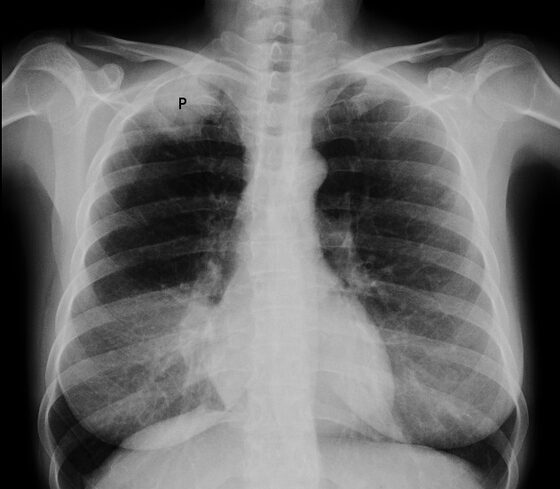
Pancoast (apical) lung tumour on chest X-ray
Jmarchn / CC BY-SA 3.0 — Wikimedia Commons
Investigations
CXR then contrast CT chest/abdomen (mass, nodes, mets, staging); biopsy (bronchoscopy/EBUS/CT-guided) for histology + molecular markers; PET-CT for staging; lung function before treatment; bloods (calcium, sodium); the histology (NSCLC vs SCLC) and stage drive management.
Management
Histology/stage-guided: NSCLC → surgery±chemo/RT/targeted; SCLC → chemo±RT; treat complications
- 1Persistent cough/haemoptysis/weight loss in a smoker → urgent CXR and 2-week-wait referral; CT chest/abdomen then biopsy for histology and molecular markers, with PET-CT and lung-function for staging/fitness.Gate: Recognise emergencies — SVC obstruction, metastatic cord compression, symptomatic hypercalcaemia; and the histology splits management: NSCLC (surgery if early) vs SCLC (chemo, usually disseminated).
- 2NSCLC → surgery for early disease ± chemo/radiotherapy, targeted/immunotherapy (EGFR/ALK/PD-L1) for advanced; SCLC → chemotherapy ± radiotherapy; treat paraneoplastic syndromes; smoking cessation and palliative care.
Key points
Smoker + persistent cough/HAEMOPTYSIS/weight loss = lung cancer → urgent CXR + 2-week-wait, CT + biopsy. NSCLC (surgery if early) vs SCLC (chemo, disseminated, paraneoplastic). Paraneoplastic clues: squamous → PTHrP hypercalcaemia; small-cell → SIADH/ectopic ACTH/Lambert-Eaton. Watch SVC obstruction, Pancoast/Horner's, cord compression.
Monitor & prognosis
Staging/treatment response, paraneoplastic markers (Ca/Na), complications; palliative needs.
Often advanced at diagnosis; early NSCLC resectable; SCLC chemo-responsive but relapses; overall poor.
Source: NICE NG122 (lung cancer); NG12 (referral); cross-ref endocrine (paraneoplastic), neurology (Lambert-Eaton)