Pneumonia
Infection of the lung parenchyma — Strep. pneumoniae commonest CAP; atypicals & HAP organisms vary
Overview
Infection and consolidation of the lung parenchyma. Community-acquired pneumonia (CAP) is graded by CURB-65 to decide setting and antibiotics; the commonest organism is Streptococcus pneumoniae. Recognise the atypical and aspiration patterns, hospital-acquired pneumonia, and the high-yield organism clues. CXR consolidation confirms it; the severity score drives where and how the patient is treated.
Recognise
- Fever, productive cough, pleuritic chest pain, breathlessness; focal coarse crackles, bronchial breathing, dullness to percussion, raised inflammatory markers
- CXR: consolidation (air bronchograms); CURB-65 (Confusion, Urea >7, RR ≥30, BP <90/≤60, age ≥65) grades severity
- Organism clues: Mycoplasma (young, dry cough, erythema multiforme, haemolysis), Legionella (hyponatraemia, deranged LFTs, travel/air-con), Klebsiella (alcoholics, 'red-currant jelly' sputum), Staph (post-influenza, cavitating), PCP (HIV, desaturation on exertion)
Red flags
- CURB-65 high (3–5) / sepsis → hospital/ICU assessment; respiratory failure → oxygen/ventilatory support
- Parapneumonic effusion turning to empyema (persistent fever, loculated effusion) → chest drain (see empyema)
Differentials & how to tell them apart
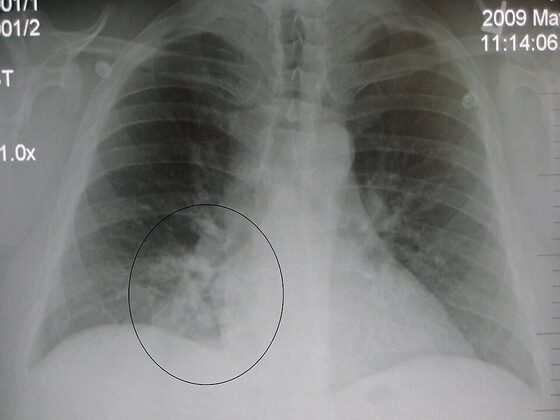
Right lower lobe consolidation (pneumonia) on chest X-ray
James Heilman, MD / CC BY 3.0 — Wikimedia Commons
Investigations
CXR (consolidation); CURB-65 (severity); FBC/CRP/U&Es (urea for the score), blood cultures, sputum culture; pneumococcal/Legionella urinary antigens for severe CAP; ABG if hypoxic; HIV test if PCP suspected.
Management
CURB-65-guided antibiotics (amoxicillin → +macrolide → IV co-amoxiclav+macrolide) + supportive care
- 1Confirm with CXR consolidation and score severity with CURB-65; send cultures (+ urinary antigens if severe). Treat by score: low → oral amoxicillin at home; moderate → amoxicillin + macrolide; severe → IV co-amoxiclav + macrolide in hospital/ICU.Gate: Use the organism clues (Legionella → hyponatraemia/LFTs; Mycoplasma → young/dry/haemolysis; Klebsiella → alcoholic/red-currant; post-flu Staph → cavitating; HIV → PCP); arrange a follow-up CXR at ~6 weeks to confirm resolution and exclude an underlying cancer.
- 2Hospital-acquired/aspiration pneumonia → broad-spectrum ± anaerobic cover per local policy; manage complications — parapneumonic effusion/empyema (drain), respiratory failure (support).
Key points
Fever + productive cough + focal consolidation = pneumonia → CURB-65 decides setting + antibiotics (amoxicillin → +macrolide → IV co-amoxiclav+macrolide). Learn the organism clues (Legionella hyponatraemia, Mycoplasma young/haemolysis, Klebsiella alcoholic red-currant, post-flu Staph cavitating, HIV→PCP). Repeat CXR at 6 weeks (exclude cancer).
Monitor & prognosis
Response/CRP, oxygenation, complications (effusion/empyema); 6-week CXR for resolution.
Most CAP recovers; severity (CURB-65), comorbidity and complications drive mortality.
Source: NICE NG138 (pneumonia)