Pulmonary tuberculosis
Mycobacterium tuberculosis — granulomatous infection, often reactivating in the apices
Overview
Infection with Mycobacterium tuberculosis, presenting after weeks-to-months with cough, weight loss, night sweats, fever and haemoptysis. It is high-yield because of the chronic presentation, the apical/cavitating CXR, the importance of risk factors (immigration from high-prevalence areas, HIV, immunosuppression), and the standard RIPE regimen with its specific drug toxicities. Latent TB is treated to prevent reactivation. (Cross-references the Infection content-map domain.)
Recognise
- Chronic (weeks-months) productive cough, haemoptysis, weight loss, night sweats, low-grade fever, malaise; risk factors — high-prevalence country of origin, HIV/immunosuppression, close contact
- CXR: upper-lobe/apical consolidation, cavitation, lymphadenopathy; miliary (millet-seed) pattern in disseminated disease
- Extrapulmonary: lymph nodes (scrofula), spine (Pott's), CNS (meningitis), pericardium, GU
Red flags
- TB meningitis / disseminated (miliary) TB → urgent treatment; airborne isolation for suspected active pulmonary TB
- Drug-resistant (MDR) TB → specialist regimens; HIV co-infection → coordinated therapy
Differentials & how to tell them apart
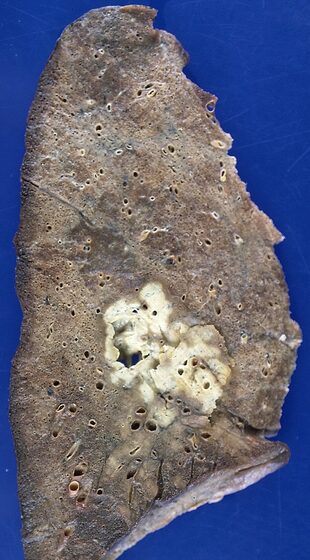
Cavitating pulmonary tuberculosis (tuberculoma) — gross pathology specimen
Yale Rosen / CC BY-SA 2.0 — Wikimedia Commons
Investigations
Sputum (≥3 samples) for acid-fast bacilli microscopy + culture (the reference standard) + rapid molecular (NAAT/Xpert for TB and rifampicin resistance); CXR (apical/cavitating); latent TB — interferon-gamma release assay (IGRA)/tuberculin test; HIV test; notify (statutory).
Management
RIPE (rifampicin/isoniazid 6 mo + pyrazinamide/ethambutol 2 mo) + pyridoxine; isolate + notify
- 1Suspect from chronic cough + weight loss/night sweats/haemoptysis + risk factors + apical/cavitating CXR; isolate and send sputum for AFB microscopy, culture and rapid molecular testing (plus HIV test). Notify.Gate: Treat active TB with RIPE (2 months RIPE → 4 months RI) and give pyridoxine with isoniazid; know the toxicities — ethambutol → optic neuritis (check vision), rifampicin → orange secretions/enzyme induction, isoniazid/pyrazinamide → hepatotoxicity.
- 2Treat latent TB to prevent reactivation in high-risk patients; manage drug-resistant TB and HIV co-infection in specialist services; contact-trace. (Cross-references the Infection page.)
Key points
Chronic cough + weight loss + night sweats + haemoptysis + apical/cavitating CXR + risk factors = pulmonary TB → sputum AFB/culture/NAAT, isolate, notify, RIPE (+pyridoxine with isoniazid). Toxicities: Ethambutol→optic neuritis, Rifampicin→orange/inducer, Isoniazid→neuropathy/hepatotoxic, Pyrazinamide→hepatotoxic/gout.
Monitor & prognosis
Sputum conversion, adherence (DOT), LFTs, visual acuity (ethambutol); contact tracing.
Curable with adherence to the full regimen; resistance/HIV/late presentation worsen outcomes.
Source: NICE NG33 (TB); cross-ref Infection domain, child_health (BCG)