Acute coronary syndrome (ACS)
Coronary plaque rupture + thrombosis → acute myocardial ischaemia/infarction
Overview
The spectrum of acute myocardial ischaemia from plaque rupture: STEMI (full-thickness, ST elevation, troponin rise), NSTEMI (ST depression/T-wave change + troponin rise) and unstable angina (ischaemic symptoms, no troponin rise). Immediate management is shared (MONA + dual antiplatelet + anticoagulation); the fork is reperfusion — STEMI needs emergency PCI, NSTEMI is risk-stratified (GRACE) for inpatient angiography.
Recognise
- Central crushing chest pain >15 min at rest, radiating to jaw/arm, with sweating, nausea, breathlessness; not relieved by GTN
- STEMI: ST elevation ≥1 mm in ≥2 contiguous limb leads or ≥2 mm chest leads, or new LBBB; reciprocal change
- NSTEMI: ST depression / T-wave inversion + troponin rise; UA: ischaemic symptoms with normal troponin
- Silent/atypical presentations in diabetics, women and the elderly (dyspnoea, epigastric pain, collapse)
Red flags
- ST elevation / new LBBB → primary PCI within 120 min of first medical contact (thrombolysis if PCI not available in time)
- Cardiogenic shock, ventricular arrhythmia, mechanical complication (papillary muscle/septal/free-wall rupture) → emergency
- Posterior MI: tall R + ST depression in V1–V3 — easily missed; do posterior leads
Differentials & how to tell them apart
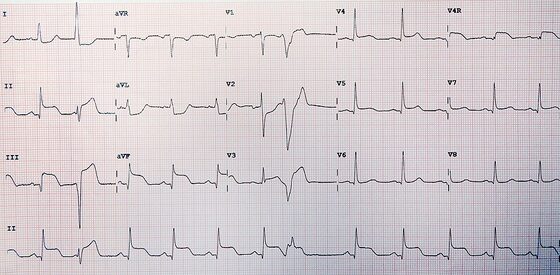
STEMI — ST-segment elevation on the 12-lead ECG
Andrewmeyerson / CC BY-SA 4.0 — Wikimedia Commons
Investigations
Immediate 12-lead ECG (repeat/serial); high-sensitivity troponin at 0 and 3 h (rise/fall = infarction). FBC, U&Es, glucose, lipids; CXR; echo for function/complications. Coronary angiography is diagnostic and therapeutic.
Management
Aspirin 300 mg + 2nd antiplatelet + anticoagulation; STEMI → primary PCI, NSTEMI → GRACE-guided angiography
- 1ECG + troponin. Give aspirin 300 mg, a second antiplatelet, anticoagulation, GTN and analgesia; oxygen only if SpO2 <94%.Gate: ST elevation or new LBBB → primary PCI within 120 min of first medical contact (fibrinolysis only if timely PCI impossible). No ST elevation → NSTEMI/UA pathway.
- 2NSTEMI/UA: fondaparinux + ticagrelor, risk-stratify with GRACE; coronary angiography ± PCI within 72 h (immediately if unstable/ongoing ischaemia).
- 3All: start the five secondary-prevention drugs (dual antiplatelet, statin, ACE inhibitor, beta-blocker, ± MRA if EF reduced), cardiac rehabilitation and risk-factor modification.
Key points
Cardiac-sounding chest pain at rest → ECG + troponin. ST elevation/new LBBB = STEMI → primary PCI within 120 min. No ST elevation + troponin rise = NSTEMI → GRACE then angiography. Oxygen only if SpO2 <94%; exclude dissection before anticoagulating if features fit.
Monitor & prognosis
Continuous ECG/telemetry, serial troponin, echo for LV function and mechanical complications; secondary-prevention adherence.
Depends on infarct size, time to reperfusion and LV function; early PCI markedly improves survival.
Source: NICE NG185 (acute coronary syndromes)