Atrial fibrillation & flutter
Disorganised atrial electrical activity → irregular ventricular response (AF) / macro-reentrant atrial circuit (flutter)
Overview
The commonest sustained arrhythmia. AF = chaotic atrial activity with an irregularly irregular pulse and no P waves; flutter = a re-entrant circuit giving sawtooth flutter waves, often 2:1 (ventricular ~150). Management has three arms: rate vs rhythm control, and — crucially — stroke prevention guided by CHA₂DS₂-VASc, with a DOAC first-line.
Recognise
- Irregularly irregular pulse; palpitations, breathlessness, fatigue, chest discomfort; may be asymptomatic
- ECG: absent P waves with irregular QRS (AF); sawtooth flutter waves with regular ventricular rate (flutter)
- Causes — the mnemonic SMITH: Sepsis, Mitral valve disease, Ischaemia/IHD, Thyrotoxicosis, Hypertension; also alcohol, PE
Red flags
- Haemodynamic instability (shock, syncope, ischaemia, heart failure) → emergency synchronised DC cardioversion
- AF with a very broad/irregular fast tachycardia → consider WPW; AVOID AV-node blockers (digoxin/verapamil) which can accelerate the accessory pathway
Differentials & how to tell them apart
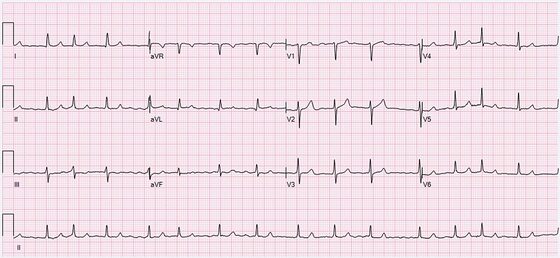
Atrial fibrillation — irregularly irregular rhythm with absent P waves (ECG)
Ewingdo / CC BY-SA 4.0 — Wikimedia Commons
Investigations
12-lead ECG (irregular, no P waves / flutter waves); ambulatory monitor for paroxysmal AF. FBC, U&Es, TFTs (exclude thyrotoxicosis), echo (structural/valve disease). CHA₂DS₂-VASc for stroke risk; ORBIT for bleeding risk.
Management
Rate control (beta-blocker or rate-limiting CCB) + anticoagulation by CHA₂DS₂-VASc (DOAC first-line)
- 1Assess stability. Stratify stroke risk with CHA₂DS₂-VASc and start a DOAC if indicated; assess bleeding with ORBIT. Control rate with a beta-blocker or rate-limiting CCB.Gate: If haemodynamically unstable (shock, syncope, ischaemia, severe heart failure) → emergency synchronised DC cardioversion, don't titrate drugs.
- 2Consider rhythm control (flecainide/amiodarone or cardioversion) if symptomatic despite rate control, new-onset/reversible cause, or AF-driven heart failure.Gate: Elective cardioversion of AF >48 h needs ≥3 weeks of therapeutic anticoagulation first (or a TOE to exclude atrial thrombus) — otherwise risk of embolic stroke.
- 3Catheter ablation for drug-refractory paroxysmal/persistent AF or typical flutter; pace-and-ablate for refractory rate control.
Key points
Irregularly irregular pulse with no P waves = AF → CHA₂DS₂-VASc decides anticoagulation (DOAC first-line), then rate control (beta-blocker/rate-limiting CCB). Unstable → DC cardioversion. >48 h before elective cardioversion = 3 weeks' anticoagulation or TOE first. Falls risk alone is NOT a reason to withhold a DOAC.
Monitor & prognosis
Rate/symptom control, renal function for DOAC dosing, annual stroke/bleeding reassessment.
Good with anticoagulation; untreated AF carries a 5-fold stroke risk.
Source: NICE NG196 (atrial fibrillation)