Acute otitis media
Middle-ear infection (Strep pneumoniae, H. influenzae, Moraxella)
Overview
Acute infection of the middle ear, very common in young children (short, horizontal Eustachian tube), usually following a URTI. Ear pain and fever with a red, bulging tympanic membrane; most resolve spontaneously, so antibiotics are used selectively.
Recognise
- Otalgia (young children: ear-tugging, irritability, fever) after a URTI
- Otoscopy: red, BULGING tympanic membrane with loss of the light reflex; may perforate → purulent discharge + pain relief
- Conductive hearing loss during the episode
Red flags
- Mastoiditis (post-auricular swelling/erythema pushing the pinna forward), intracranial spread, or a child who is systemically very unwell
Differentials & how to tell them apart
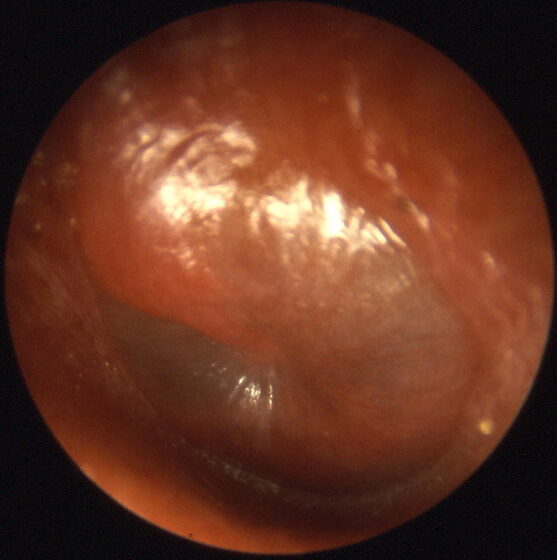
Acute otitis media — red, bulging eardrum
B. Welleschik / CC BY-SA 3.0 — Wikimedia Commons
Investigations
Clinical (otoscopy). No routine investigation. Recurrent/persistent effusion → audiometry/tympanometry later.
Management
Analgesia + safety-net; amoxicillin only if indicated (or a delayed prescription)
- 1Most resolve in ~3 days with analgesia and safety-netting. Offer an antibiotic (amoxicillin 5 days) or a back-up prescription rather than treating everyone.Gate: Reserve IMMEDIATE antibiotics for: systemically unwell, <2 years with BILATERAL AOM, otorrhoea (perforation/discharge), or high-risk comorbidity — otherwise analgesia ± a delayed prescription; over-treating AOM is the common error
- 2Penicillin allergy → clarithromycin/erythromycin. Complications (mastoiditis, facial palsy, intracranial) → urgent ENT/admission.
Key points
Bulging red drum = AOM. Most are viral/self-limiting — antibiotics change the course little. The immediate-antibiotic criteria (unwell, <2y bilateral, discharge) are high-yield.
Monitor & prognosis
Resolution in days; persistent effusion (glue ear) over weeks; recurrence.
Excellent; perforations usually heal.
Source: NICE NG91 (otitis media - acute); NICE CKS