Otitis media with effusion (glue ear)
Non-infected middle-ear effusion + Eustachian dysfunction
Overview
A collection of non-purulent fluid in the middle ear without acute infection — the commonest cause of childhood hearing loss. PAINLESS conductive hearing loss with a dull, retracted drum. Usually self-limiting; the concern is the impact of hearing loss on speech and learning.
Recognise
- Painless conductive hearing loss; in children — inattention, speech delay, "turning up the TV", behavioural issues
- Otoscopy: dull, retracted/immobile tympanic membrane, often with a fluid level or air bubbles
- Flat (type B) tympanogram; associated with cleft palate and Down syndrome
Red flags
- UNILATERAL persistent OME in an ADULT → examine the postnasal space to exclude a nasopharyngeal carcinoma obstructing the Eustachian tube
Differentials & how to tell them apart
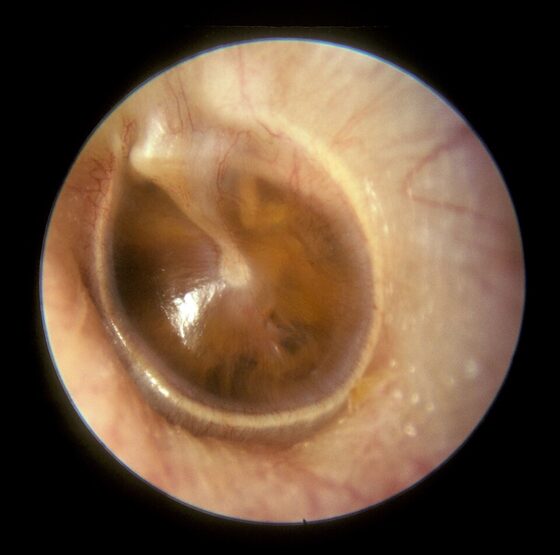
OME — dull retracted drum with effusion
Michael Hawke MD / CC BY-SA 4.0 — Wikimedia Commons
Investigations
Otoscopy + tympanometry (flat/type B) + age-appropriate audiometry (conductive loss). Active observation for ~3 months (most resolve).
Management
Active observation for ~3 months (most resolve); no antibiotics/decongestants
- 1Active observation with hearing/development monitoring for ~3 months — most resolve spontaneously. Do NOT use antibiotics, antihistamines, decongestants or intranasal steroids (ineffective).Gate: Persistent UNILATERAL OME in an ADULT must prompt examination of the postnasal space for a NASOPHARYNGEAL CARCINOMA blocking the Eustachian tube — do not just observe an adult unilateral effusion
- 2Persistent bilateral OME (≥3 months) with hearing loss affecting speech/education → ENT for grommets (ventilation tubes) ± adenoidectomy, or hearing aids; lower threshold in Down syndrome/cleft palate.
Key points
Glue ear = painless conductive loss + flat tympanogram + dull retracted drum. Watch the developmental impact. Unilateral adult OME is a red flag for nasopharyngeal cancer.
Monitor & prognosis
Hearing, speech/language, school performance; resolution over months.
Most resolve spontaneously; grommets help selected persistent cases.
Source: NICE CKS Otitis media with effusion; NICE CG60