GORD & Barrett oesophagus
Reflux of gastric contents through an incompetent lower oesophageal sphincter
Overview
Gastro-oesophageal reflux disease — symptomatic reflux of acid through an incompetent lower oesophageal sphincter, causing heartburn and regurgitation. Managed with lifestyle change and a full-dose PPI. Chronic reflux can cause Barrett oesophagus (intestinal metaplasia — a pre-malignant change needing surveillance). The key skill is recognising ALARM features that mandate endoscopy.
Recognise
- Burning retrosternal discomfort (heartburn) and acid regurgitation, worse lying down/after meals/bending
- Waterbrash, nocturnal cough, hoarseness, dental erosion; often overweight/smoker, hiatus hernia
- Barrett: columnar (intestinal) metaplasia at the lower oesophagus on endoscopy — pre-malignant (adenocarcinoma risk), needs surveillance
Red flags
- ALARM features → urgent endoscopy: Anaemia (iron-deficiency), Loss of weight, Anorexia, Recent-onset/progressive symptoms, Melaena/haematemesis, Swallowing difficulty (dysphagia)
- Dysphagia or age ≥55 with weight loss + upper abdominal pain/reflux/dyspepsia → 2-week-wait endoscopy
Differentials & how to tell them apart
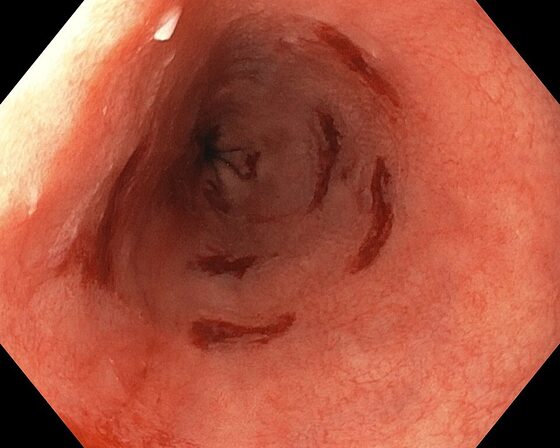
Barrett oesophagus — salmon-pink columnar metaplasia at the lower oesophagus (endoscopy)
Samir / CC BY-SA 4.0 — Wikimedia Commons
Investigations
Clinical diagnosis. Endoscopy (OGD) for ALARM features/refractory symptoms (oesophagitis grade, Barrett, exclude cancer). Do NOT test for H. pylori in proven GORD. 24-h pH/manometry pre-surgery.
Management
Lifestyle + full-dose PPI (4 weeks; 8 weeks if severe oesophagitis)
- 1Lifestyle measures (weight loss, smoking cessation, trigger avoidance) + full-dose PPI for 4 weeks (8 weeks for severe oesophagitis), then long-term maintenance PPI. Review medications that worsen reflux.Gate: Do NOT test for H. pylori in PROVEN GORD; ANY ALARM feature (dysphagia, weight loss, anaemia, GI bleeding, or age ≥55 with persistent symptoms) → urgent endoscopy, not just a PPI trial
- 2Refractory/complicated → endoscopy, optimise PPI, consider fundoplication. Barrett → surveillance endoscopy ± radiofrequency ablation for dysplasia.
Key points
Heartburn + regurgitation = GORD → lifestyle + PPI; don't H. pylori-test proven GORD. The whole skill is spotting ALARM features (dysphagia/weight loss/anaemia/bleeding) for urgent endoscopy. Barrett's (metaplasia) is the pre-malignant sequel.
Monitor & prognosis
Symptom response; Barrett surveillance; deprescribe/step-down PPI where possible.
Good; small adenocarcinoma risk via Barrett.
Source: NICE NG (GORD/dyspepsia); CKS Dyspepsia – proven GORD