Chronic leukaemia (CLL & CML)
Clonal proliferation of mature lymphocytes (CLL) or myeloid cells (CML, BCR-ABL/Philadelphia)
Overview
Indolent leukaemias of MATURE cells, often found incidentally on a routine FBC. Chronic lymphocytic leukaemia (CLL) is a clonal expansion of mature B-lymphocytes (lymphocytosis, smear/smudge cells) in older adults. Chronic myeloid leukaemia (CML) is a myeloproliferative disorder with the Philadelphia chromosome (BCR-ABL, t(9;22)) causing a raised neutrophil/myeloid count and massive splenomegaly, transformed by targeted tyrosine kinase inhibitors.
Recognise
- CLL: often asymptomatic incidental LYMPHOCYTOSIS in an older adult; lymphadenopathy, hepatosplenomegaly; SMEAR (smudge) cells on film; can cause autoimmune haemolysis and recurrent infections
- CML: raised WCC with the whole myeloid series, MASSIVE splenomegaly, hypermetabolic symptoms; PHILADELPHIA chromosome (BCR-ABL, t(9;22)); can transform to blast crisis
- CLL complications: Richter transformation (to aggressive lymphoma), autoimmune haemolytic anaemia, hypogammaglobulinaemia (infections)
Red flags
- CLL with rapidly enlarging node/systemic symptoms → Richter transformation
- CML blast crisis (rising blasts) → transformation to acute leukaemia
Differentials & how to tell them apart
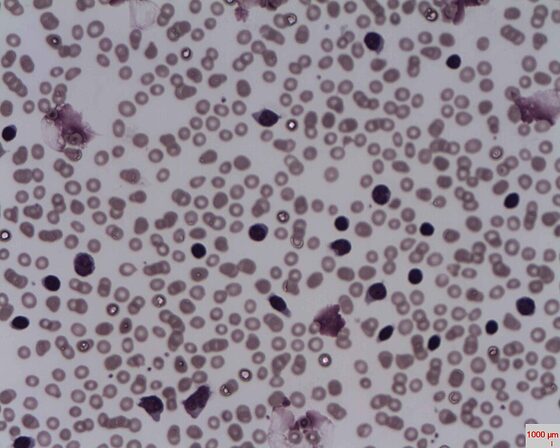
CLL — lymphocytosis with smear (smudge) cells (blood film)
Prof. Erhabor Osaro / CC BY-SA 4.0 — Wikimedia Commons
Investigations
FBC (lymphocytosis in CLL; neutrophilia/myeloid in CML), blood FILM (smear cells in CLL); CLL — immunophenotyping (flow cytometry) for clonal B-cells; CML — BCR-ABL/Philadelphia chromosome (cytogenetics/molecular); marrow/imaging for staging.
Management
CLL → watch-and-wait then targeted therapy if progressive; CML → tyrosine kinase inhibitor (imatinib)
- 1Distinguish CLL (mature lymphocytosis + smear cells, confirm with flow cytometry) from CML (myeloid proliferation + massive splenomegaly + BCR-ABL/Philadelphia chromosome). Early asymptomatic CLL → watch-and-wait.Gate: CML is defined by the Philadelphia chromosome (BCR-ABL) and treated with a tyrosine kinase inhibitor (imatinib); a rapidly enlarging node in CLL suggests Richter transformation.
- 2CLL active disease → chemo-immunotherapy/targeted agents (BTK inhibitor/venetoclax), manage autoimmune haemolysis/infections; CML → imatinib, transplant for transformation.
Key points
Incidental mature LYMPHOCYTOSIS + smear cells in an older adult = CLL (flow cytometry; watch-and-wait if early; Richter transformation, autoimmune haemolysis). Myeloid proliferation + MASSIVE splenomegaly + PHILADELPHIA chromosome (BCR-ABL) = CML → tyrosine kinase inhibitor (imatinib).
Monitor & prognosis
Counts/lymphocyte doubling time (CLL), BCR-ABL response (CML), transformation, infection.
CLL often indolent (many never treated); CML transformed by TKIs to near-normal life expectancy.
Source: BSH CLL/CML