Multiple myeloma
Malignant clonal plasma-cell proliferation → monoclonal paraprotein + end-organ damage
Overview
A malignancy of plasma cells producing a monoclonal immunoglobulin (paraprotein) and causing end-organ damage summarised by CRAB: hyperCalcaemia, Renal impairment, Anaemia, Bone lesions (lytic). It affects older adults and presents with bone pain/fractures, anaemia, renal failure or recurrent infection. Diagnosis combines paraprotein (serum/urine electrophoresis, free light chains), marrow plasmacytosis and end-organ damage.
Recognise
- CRAB: hyperCalcaemia (thirst, confusion, constipation), Renal impairment (cast nephropathy/light chains), Anaemia (marrow infiltration), Bone lesions — lytic 'punched-out' lesions, pathological fractures, back pain, cord compression
- Older adult; recurrent infections (immunoparesis), hyperviscosity, raised ESR; Bence-Jones protein (urinary free light chains); ROULEAUX on film
- X-ray: lytic lesions, 'pepper-pot' skull; raised total protein with a paraprotein band
Red flags
- Hypercalcaemia, acute kidney injury, or metastatic spinal cord compression → emergencies
- Hyperviscosity (visual disturbance, confusion, bleeding) → plasmapheresis
Differentials & how to tell them apart
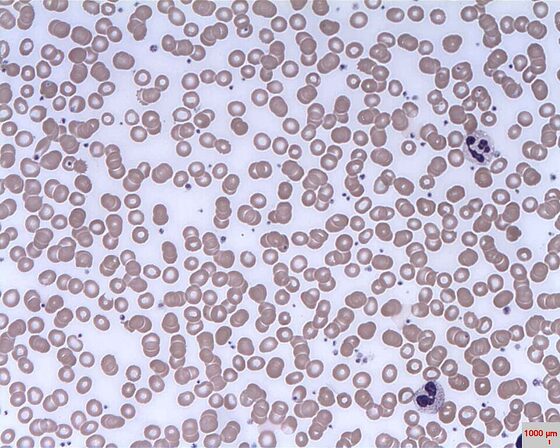
Rouleaux formation (stacked red cells) in myeloma (blood film)
Osaretin / CC BY-SA 4.0 — Wikimedia Commons
Investigations
Serum + urine protein ELECTROPHORESIS (paraprotein/Bence-Jones), serum free light chains; FBC (anaemia, rouleaux), calcium, U&Es (renal), ESR; skeletal survey/whole-body MRI or CT (lytic lesions); bone marrow (clonal plasma cells); beta-2 microglobulin for staging.
Management
Supportive (hypercalcaemia/renal/bone) + systemic anti-myeloma therapy ± stem-cell transplant
- 1Suspect from CRAB features in an older adult; confirm with serum/urine electrophoresis + free light chains, marrow plasmacytosis and imaging for lytic lesions. Treat the CRAB complications.Gate: Hypercalcaemia, AKI (cast nephropathy), cord compression or hyperviscosity are emergencies; a paraprotein WITHOUT CRAB/end-organ damage is MGUS (monitor), not myeloma.
- 2Systemic anti-myeloma therapy (proteasome inhibitor/immunomodulator/steroid ± anti-CD38), autologous stem-cell transplant in eligible patients, bisphosphonates and supportive care.
Key points
Older adult + CRAB (hyperCalcaemia, Renal impairment, Anaemia, Bone lytic lesions/back pain) + paraprotein + Bence-Jones + rouleaux = multiple myeloma → electrophoresis + free light chains + marrow + skeletal imaging. Emergencies: hypercalcaemia, AKI, cord compression, hyperviscosity. Paraprotein without CRAB = MGUS (monitor).
Monitor & prognosis
Paraprotein/free light chains, calcium/renal function, bone disease, treatment response/relapse.
Not curable but increasingly treatable with prolonged survival; relapsing-remitting.
Source: NICE NG35 (myeloma); cross-ref renal (cast nephropathy), endocrine (hypercalcaemia), MSK (cord compression/bone)